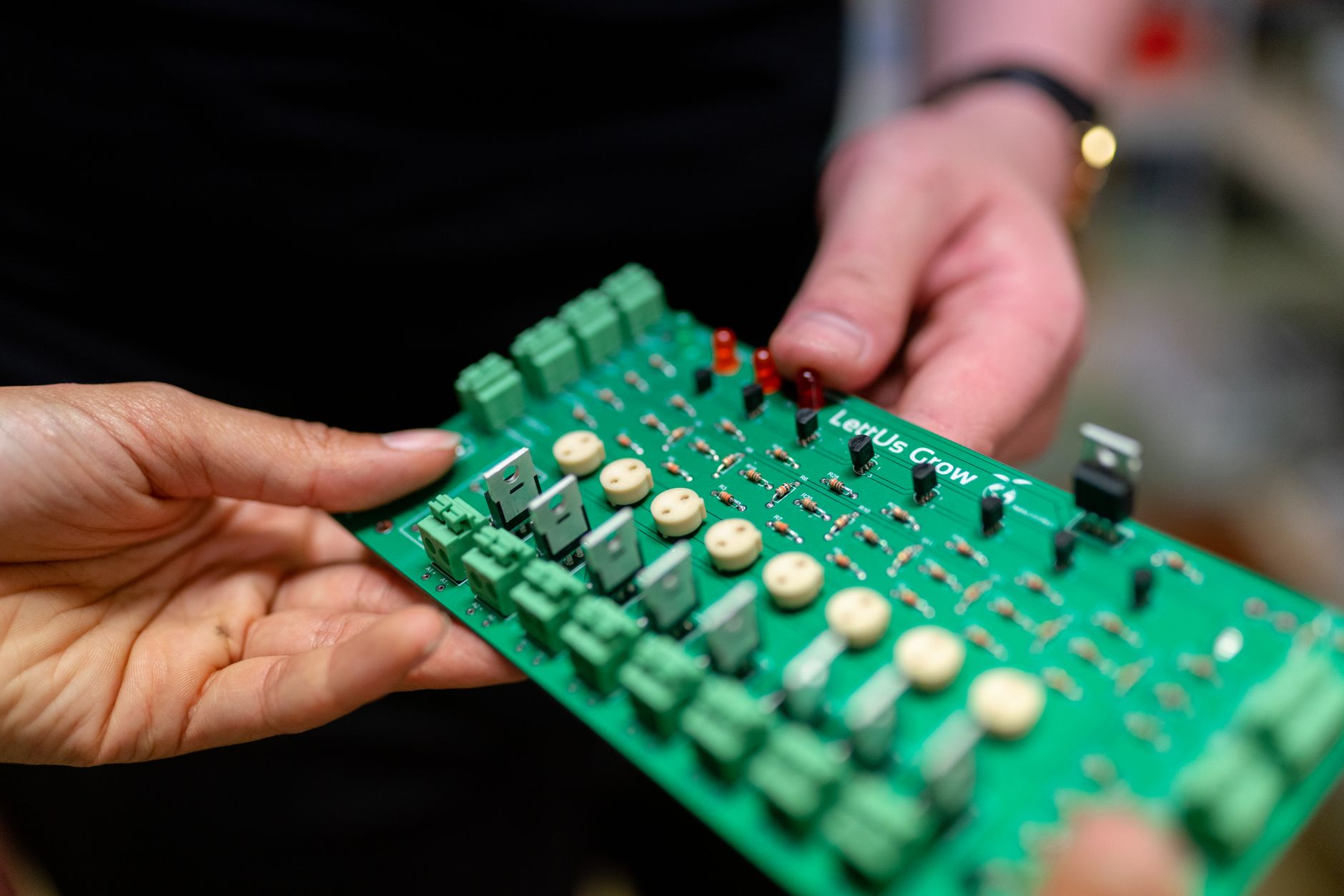
Artificial intelligence will not remain confined to data centers. A growing share of models will need to run directly on the machines that collect data: industrial sensors, medical devices, robots, cars, scientific instruments, and embedded systems. The acquisition of Alif Semiconductor by Analog Devices, announced for a value of approximately 1.35 billion dollars, should be viewed precisely through the lens of this transformation.
Analog Devices is one of the world's leading specialists in analog and mixed-signal semiconductors, components that translate the physical world into signals usable by digital systems. Alif, founded in 2019, builds microcontrollers and processors designed to run machine learning workloads with very low power consumption. Bringing the two skill sets together means bringing artificial intelligence closer to the point where data originates.
From sensor to model without passing through the cloud
A traditional industrial system can acquire a signal, send it to a computer or server, and wait for a decision. Edge AI aims to compress this path: the device interprets locally what it sees, hears, or measures. The advantage is latency, but also privacy, reliability, and reduced required bandwidth.
In a factory, a motor can detect an abnormal vibration before a breakdown; a healthcare device can classify a signal without continuously sending sensitive data; a robot can react to an obstacle without waiting for a response from the network. These applications require chips very different from data center GPUs: they must consume just a few milliwatts or watts, operate for years, and function in environments where cooling is limited.
Alif built its advantage on efficiency
Alif's Ensemble family combines Arm cores with Ethos-U neural accelerators and proprietary power management technologies. The company has focused on the problem of running AI inference while maintaining power consumption compatible with embedded and battery-powered devices.
For Analog Devices, this capability complements an already very strong position in sensors and signal conversion. The company is present in industrial automation, automotive, healthcare, communications, and instrumentation: precisely the markets where local AI can transform a component that measures into a component that interprets.
Physical AI needs analog
Large models have popularized the idea that AI is primarily software, but any system that interacts with the real world must first convert temperature, light, pressure, sound, or motion into data. This interface is the historical domain of Analog Devices.
The more artificial intelligence enters robots and machines, the more the value of the entire chain between sensor and decision grows. A lightning-fast accelerator is of little use if the input signal is noisy or if the system consumes too much power to remain always on. The acquisition of Alif suggests that semiconductor manufacturers see this very integration as one of the next markets.
A 1.35 billion dollar acquisition is also a bet on the fragmentation of AI
There will not be a single model running on a single type of chip. Data centers will continue to handle training and complex inference, smartphones and PCs will run personal models, and billions of microcontrollers will perform smaller but continuous tasks. The number of inferences performed at the edge could therefore become massive, even if each individual operation requires little power.
It is a market where competitive advantage does not depend on building the largest model, but on managing to run the model well enough within a tiny power budget.
The limitation remains software
Embedded hardware can be excellent yet remain difficult to use if developers lack optimized toolchains, libraries, and models. This is one of the reasons why the Arm ecosystem and standardized accelerators have gained importance. Analog Devices will need to make the integration of Alif straightforward for customers who often design products with much longer lifecycles than consumer electronics.
The transaction will also need to complete the standard regulatory process and, like any acquisition, the ability to retain talent and integrate different roadmaps will be decisive.
Artificial intelligence becomes invisible infrastructure
While the first phase of generative AI was dominated by chatbots and GPUs, the next phase could be much less visible. An algorithm that detects a failure inside an industrial pump or regulates a medical device does not necessarily produce a spectacular screen, but it can create value every second for years.
This is where the acquisition of Alif takes on a broader meaning than the price paid. Analog Devices is betting that artificial intelligence will progressively stop being a standalone feature and become an embedded property of devices. When that happens, a huge part of AI will no longer be something we connect to: it will be something working silently inside the machines around us.


