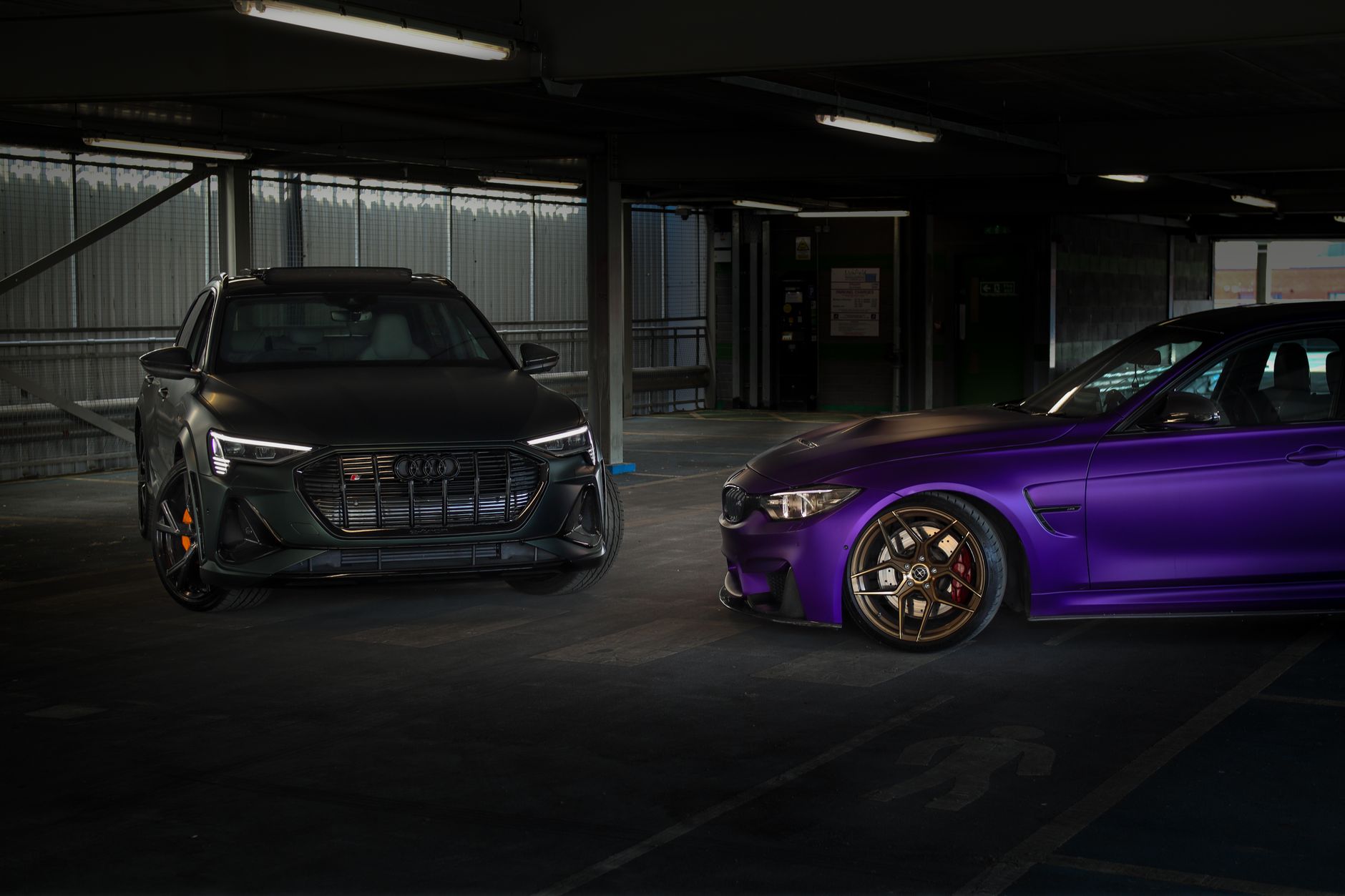
Ultra-high-performance station wagons remain a niche segment, yet they illustrate with particular clarity the transformation sweeping the European automotive industry. A road comparison between the Audi RS 5 Avant and the BMW M3 Touring pits two now-divergent interpretations of the same concept against each other: an estate capable of carrying passengers and luggage without sacrificing top-tier sports car performance.
On one side is the BMW M3 Touring, whose design remains faithful to the twin-turbo petrol inline-six, free of electrification and paired with all-wheel drive. On the other, the Audi RS 5 Avant makes its debut as the indirect successor to the RS 4 Avant, retaining the 2.9 twin-turbo V6 but integrating it into a plug-in hybrid system. The goal is not merely to reduce fuel consumption on routes where electric power can play a role; the electric component is also used to raise the bar for overall power output.
For Audi, the transition holds symbolic as well as commercial value. The Ingolstadt-based manufacturer helped define the high-performance wagon formula with the RS 2 Avant developed with Porsche, later carrying it forward through generations of the RS 4 and RS 6. The decision to extend the RS 5 moniker to the Avant body style as well, following the overhaul of the A4/A5 lineup, marks a departure in nomenclature but not in strategy: preserving a daily-drivable high-performance model while adapting it to the technical and regulatory constraints reshaping the market.
Two architectures, a similar audience
The RS 5 Avant arrives with a claimed 630 hp from its V6 plug-in hybrid system and standard all-wheel drive. According to data reported in the British road test, the 0-62 mph sprint takes 3.6 seconds. That figure firmly places the car in the territory of supercars from just a few years ago, all while retaining the layout of a five-door station wagon. Audi quotes a UK starting price of £91,300 for the Avant version; Carbon Black, Vorsprung, and Launch Edition trims are also planned, while the saloon starts at £89,400.
The BMW M3 Touring responds without relying on a battery and electric motor. It is a significant exception in its own history: for decades, the M3 badge was associated with sedans, coupes, and convertibles—with the coupe later becoming the M4—but never a wagon. With the current generation, BMW has finally expanded the M3 family to the Touring, openly stepping into territory where Audi boasts a much longer tradition.
Both models therefore adopt all-wheel drive, a choice that has become central in this segment to manage high power outputs in all conditions and deliver repeatable performance. But the way that performance is achieved is radically different. BMW continues to offer a model aimed at those seeking the mechanical character of a turbocharged six-cylinder and a direct connection with the engine and transmission. Audi adds complexity: an internal combustion engine, an electric component, and external charging become part of the user experience.
For a buyer, the distinction matters even far from a mountain road or a track. A plug-in hybrid can truly showcase its advantage especially if recharged regularly and if a significant share of daily driving takes place over distances suited to electric use. If, instead, it is used primarily for long journeys without recharging, the benefit depends far more on the type of route and energy management. In the cited test, the RS 5 Avant achieved an efficiency of 33 mpg; Audi also claims a total range of 334 miles. These figures are useful to put the car into context, but they are no substitute for evaluating real-world running costs based on each owner's specific habits.
Electrification also changes the character of the sports car
The showdown between the two wagons is therefore not simply a horsepower race. Plug-in hybridization brings with it mass, additional components, and more complex software management, but it allows electric torque to be paired with a turbocharged engine. In a segment where buyers expect instantaneous response, fierce acceleration, and versatility, the quality of integration between the two power sources becomes just as decisive as the peak output figure.
The comparison also highlights a recurring tension in the engineering of electrified sports cars: the attempt to preserve an emotional combustion engine element within a system that, under certain conditions, can be far quieter. Testers noted that on the RS 5, part of the powertrain sound is played through the speakers. It is a widespread solution across the industry, designed to provide the driver with acoustic feedback consistent with performance, but one that does not necessarily convince those who associate the appeal of an RS with the natural sound of the V6.
BMW, by choosing an unelectrified path for the M3 Touring, avoids this specific compromise and safeguards a more traditional offering. This does not mean its approach is immune to the pressures weighing on the entire industry. Emissions regulations, fleet targets, and taxation are squeezing the space for purely combustion-powered high-performance models, especially in European markets. The RS 5 Avant therefore also represents a potential glimpse into how premium performance divisions plan to extend the life of combustion engines during the transition.
The industrial value of a niche
Fast station wagons do not drive the volumes of SUVs and crossovers, but their brand image carries weight far beyond their sales figures. They bring together elements that are difficult to reconcile: family space, long-distance comfort, perceived quality, and extreme performance. For brands like Audi and BMW, they also serve as technology showcases, putting on display engineering choices regarding drivetrain, control electronics, power management, and, in Audi’s case, electrification.
The comparison comes at a time when model line-ups are being redefined. Audi has replaced the A4 with the A5 and consequently reorganized its performance offering: the RS 4 Avant bows out, and the RS 5 assumes its role in saloon and Avant versions. BMW, by contrast, is consolidating a historic nameplate with a body style that was previously missing. For enthusiasts, the most tangible outcome is a choice between two philosophies, not merely two cars: sticking with pure combustion power, or accepting that access to peak performance now runs through a plug-in hybrid powertrain.
It is not a painless transition. A PHEV in this category requires home or workplace charging infrastructure to truly make sense of its logic, whereas the simplicity of a petrol-only vehicle remains immediate. At the same time, the hybrid architecture can make the RS 5 better suited to contexts where efficiency and the ability to drive with reduced local emissions become important, without sacrificing the claimed 630 CV.
The battle between the RS 5 Avant and M3 Touring therefore does not yield a one-size-fits-all answer. Rather, it marks the moment when the large performance estate must prove it can remain desirable using new technical tools. Audi has chosen to make electrification a substantial part of its RS offering; BMW still provides a benchmark for those who prioritize mechanical continuity. Over the coming years, demand, regulations, and manufacturers' ability to keep weight and complexity in check will determine which of the two paths becomes the rule in this niche.


