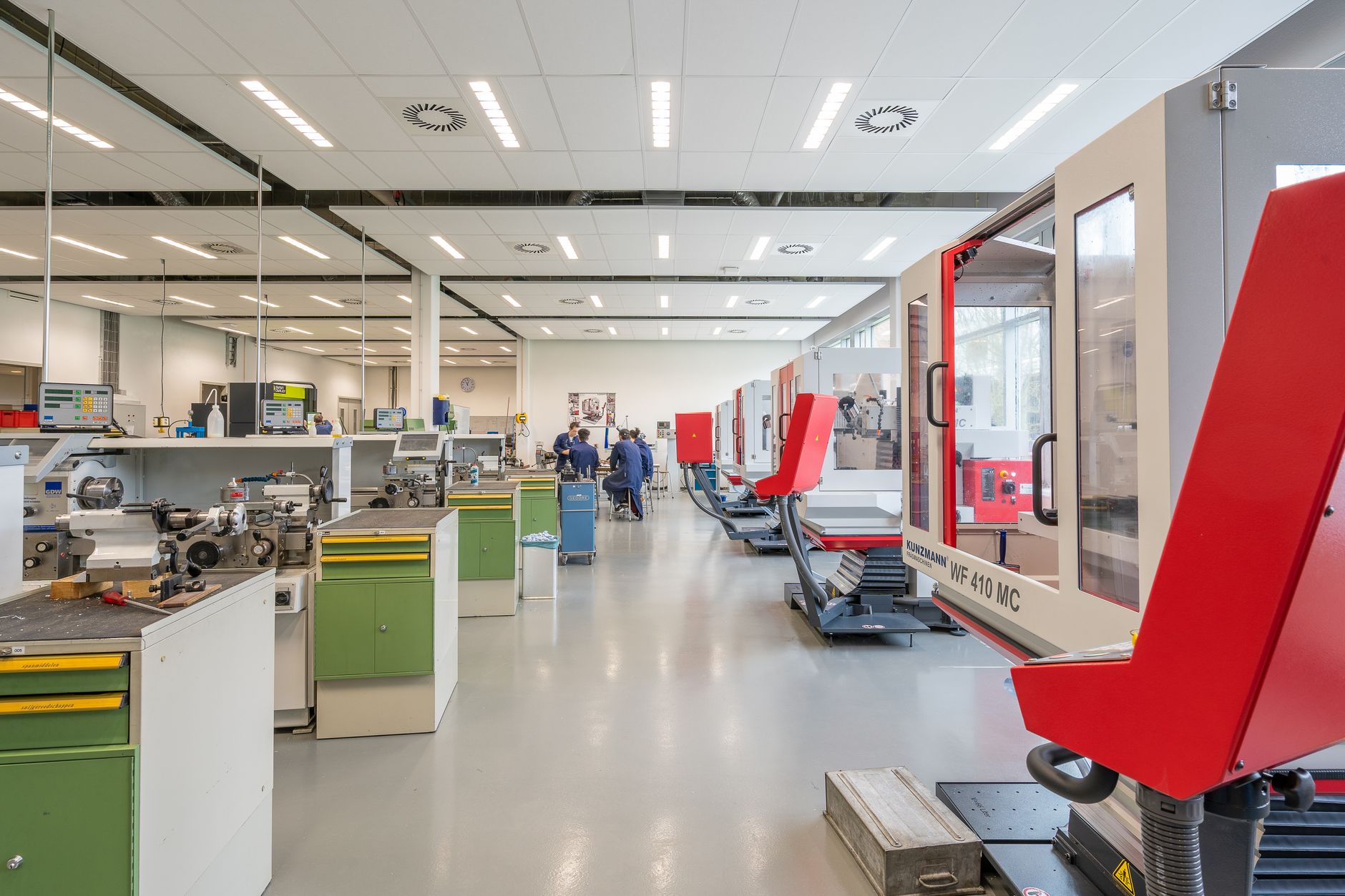
When talking about artificial intelligence applied to manufacturing, the imagination immediately jumps to fully autonomous factories, humanoid robots, operator-free assembly lines, and facilities designed from scratch to run virtually without human intervention. CloudNC is taking a far less spectacular and, for that very reason, potentially more practical path: taking existing machine shops—with their machinery, software, and machinists—and automating the steps that currently waste the most time.
The British startup has announced a new $20 million investment to accelerate the adoption of CAM Assist, its AI-powered software for programming CNC machines. The round was led by Nimble Ventures, with participation from Calculus Venture Capital, Entrepreneur First, and LM Ventures, the venture capital fund of Lockheed Martin. According to TechCrunch, the funding brings the total capital raised by the company since its founding to approximately $128 million.
The figure itself is not enormous when compared to the billions currently being poured into foundation AI models. But that is precisely the point: CloudNC operates in a segment where value does not come from building a bigger model, but from successfully penetrating industrial processes that are complex, expensive, and difficult to change. CNC machines are used to cut and machine materials with extreme precision, producing components for automotive, aerospace, defense, electronics, and countless other industries. Before a machine starts cutting, however, someone has to decide how to produce the part: which tools to use, which approach direction to take, and at what speeds, feeds, and sequences.
The problem is not the machine: it is everything that happens before it
Computer numerical control machines are already highly automated. Once loaded with the correct program, they can execute extremely complex machining operations with precision and repeatability. The bottleneck often remains in the preceding phase, where a CAM programmer translates a digital model into a concrete machining strategy.
It is work that requires experience. It is not enough to tell the machine what shape to achieve: one must determine how to clamp the part, which tools are suitable, which areas to avoid, what order to execute the operations in, and which parameters strike the right balance between speed, quality, and tool life. Traditional CAM software helps build this process, but in many cases, the programmer still has to manually define a significant part of the strategy.
CAM Assist fits right in here. The software integrates with platforms already widespread in machine shops, automatically generating machining strategies and toolpaths. CloudNC explains that the system can select tooling, approach directions, speeds, and feeds, and prepare an initial version of the program. However, the machinist remains in the loop: they can review, edit, and approve what the AI proposes before the code is run on the machine.
It is a form of automation that differs sharply from the narrative of total human labor replacement. The stated goal is to compress the time required for repetitive tasks, leaving the more complex decisions to the operator. CloudNC itself claims that CAM Assist can complete up to 80% of certain CAM programs in minutes—a commercial claim that naturally depends on the type of machining and should be viewed as an indicator of the system's potential, rather than a guaranteed outcome in every shop.
More than a thousand machine shops: moving from demo to adoption
Perhaps the most significant takeaway from the new funding round is that CloudNC is not merely financing research. The company states that CAM Assist is already used by more than a thousand machine shops worldwide, with a particularly strong footprint in the United States. TechCrunch reports that around 80% of the company's customer base is American. Among its publicly named customers are Lockheed Martin and Major Tool and Machine.
This changes the meaning of the round. An industrial startup can showcase impressive technology in a lab and still face immense hurdles turning it into a product. On factory floors, every change must coexist with legacy software, expensive machinery, safety protocols, quality standards, and personnel who cannot simply halt production to experiment.
CloudNC has therefore opted for an integration strategy rather than a rip-and-replace approach. CAM Assist works with CAM software already established in the industry and, according to the company's website, supports environments such as Autodesk Fusion, Mastercam, Siemens, GibbsCAM, and SolidCAM, with additional integrations in development. It is a less radical approach, but one that is far easier to deploy: machine shops do not have to overhaul their entire infrastructure; they can simply add an automation layer on top of tools they already know.
The next target is quoting
The $20 million will also be used to develop new products. The most notable is called Quote Agent, which targets a problem that occurs even before programming begins: determining how much it costs to manufacture a part, and consequently what price to quote the customer.
Quoting is a critical phase in precision manufacturing. A machine shop receives a drawing or model and must estimate machine time, tooling, material, complexity, and risk. If the quote is too high, it loses the job; if it is too low, it may win the contract only to find it has taken on an unprofitable order. In many cases, this process relies on experienced engineers and takes time—right when the customer expects a quick turnaround.
CloudNC aims to use AI to automate at least part of this evaluation. The company announced that Quote Agent will arrive during 2026. While CAM Assist tries to shorten the time between design and production, Quote Agent attempts to reduce the gap between customer request and business decision. Together, the two products point to a broader strategy: rather than building the "factory AI" as a single omnipotent system, tackling the slowest steps in the supply chain one by one.
The real opportunity lies in factories that won't be rebuilt
This is where CloudNC's story becomes compelling beyond the single startup. Most of the world's manufacturing capacity will not be replaced by brand-new facilities within a few years. Machinery, software, and plants have very long lifecycles and require massive capital expenditure. For this reason, a significant portion of AI's industrial transformation will likely unfold through digital retrofits: tools that upgrade what already exists.
The economic upside can be massive even without an autonomous factory. If a machine shop can program faster, prepare quotes in less time, and increase the utilization of the machines it already owns, it can produce more without having to double its workforce or physical capital. This logic is especially critical in markets facing a shortage of highly skilled technicians.
This dynamic also ties into the reshoring trend. In the United States and Europe, governments and businesses want to bring parts of strategic production back home, but rebuilding manufacturing capacity requires more than simply opening factories. It demands programmers, operators, and technicians capable of running complex machinery. Software that makes existing staff more productive can therefore become a pillar of industrial policy, not merely a software product.
Human-machine collaboration is far less theoretical here
In white-collar work, debate constantly swirls around whether AI agents will replace entire professions. In precision manufacturing, the emerging model is more hybrid. AI can generate an initial strategy, but the cost of a physical error is vastly higher than that of an incorrect chatbot response. A flawed toolpath can ruin raw material, break a cutting tool, damage a machine, or jeopardize an entire production run.
That is why CloudNC keeps the technician in the loop. This is not just a cautious choice: it is also a pragmatic way to introduce AI into environments where tacit knowledge carries immense weight. An experienced machinist can spot issues that are not always fully captured in the part's digital data. The most valuable automation, at least today, is the kind that cuts out repetitive grunt work without pretending to eliminate that expertise.
Industrial AI could become massive without resembling a robot
The artificial intelligence race has been dominated by chatbots, generative models, and data centers. Yet some of the most enduring economic value could stem from virtually invisible software optimizing specific industrial workflows. CloudNC represents this second wave: less flashy, more vertical, but with a very direct link between automation and productivity.
The new funding round does not yet prove that the company will become a global standard. It must continue convincing highly diverse machine shops, expand integrations, demonstrate sustained ROI, and turn Quote Agent from a project into a product deployed at scale. However, the fact that over a thousand organizations have already adopted CAM Assist suggests that the demand is real.
The factory of the future, then, might not arrive in a single flashpoint where everything suddenly becomes autonomous. It could emerge gradually, injecting intelligence into every step: first quoting, then programming, then inspection, then quality control. In the end, looking back, we may realize that AI's industrial revolution didn't begin when robots replaced humans, but when software stopped waiting for step-by-step instructions and started proposing the best way to make things.


