To understand how Italian universities are changing, one must also look at what is happening outside traditional academic models, especially in degree courses where the gap between what is studied and what one will have to do professionally can become a real problem. Medicine is probably the most obvious case: knowing anatomy, physiology, pathology, and pharmacology is essential, but becoming a good doctor also means learning to make decisions under conditions of uncertainty, communicating with a frightened person, working in teams, acknowledging one's own limitations, and transforming a massive amount of scientific information into a responsible clinical choice. It is precisely on this gap between knowledge and competence that Università degli Studi Link is building a significant part of its educational offering.
Link's single-cycle master's degree program in Medicina e Chirurgia lasts six years and is worth 360 credits, as required for the LM-41 class, but the formal structure of the degree is not the most interesting element. The University states that it aims to integrate theoretical teaching, practical activities, simulations, and an education that brings together biomedical and human sciences from the very first years. From the third year, professionalizing internships begin in affiliated healthcare facilities, while clinical and research clerkships linked to thesis preparation are scheduled in the final years. The study plan already includes, right from early training, statistics for scientific research, medical anthropology, history of medicine, bioethics, scientific English, and modules dedicated to psychosocial anamnesis: an approach that seeks to avoid the concept of the physician as a mere technically competent executor and to train, at least in intention, a professional capable of understanding the patient within a broader context.
Learning Medicine before entering the ward
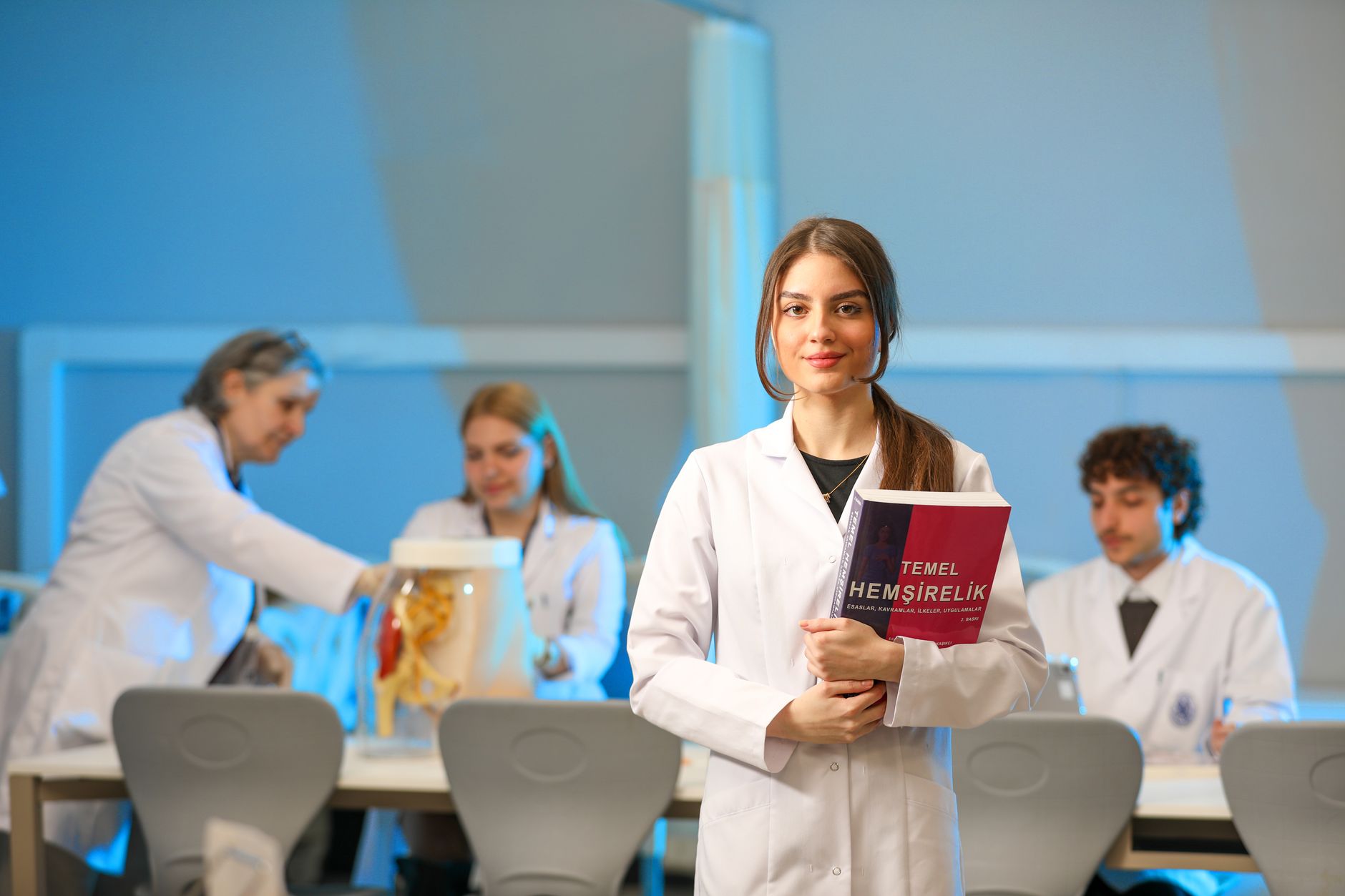
One of the aspects on which Link places the greatest emphasis is early practical experience. The course documentation provides for laboratory activities starting from the first year in spaces equipped with medical-surgical technologies and describes laboratory teaching as authentic learning by doing. This is not a minor pedagogical detail: in healthcare training, simulation makes it possible to practice procedures, reasoning, and communication before an error can have consequences on a real person, creating an environment where one can make mistakes, analyze what happened, and try again.
The teaching methodology outlined by the University includes clinical problem-solving, real-case simulations, role-playing in the doctor-patient relationship, experiential learning, and healthcare decision-making. Frontal lectures do not disappear, nor could they in a program requiring an enormous scientific foundation, but they are complemented by methods that require students to apply knowledge rather than merely repeat it. It is an important difference: knowing which symptoms characterize a pathology and facing a case where one must choose which questions to ask, which hypotheses to discard, and which tests to order are two related, yet distinct skills.
The same logic emerges in the description of internships. From the third year, students must acquire skills in major clinical fields, from internal medicine to general surgery, pediatrics, obstetrics and gynecology, through to cardiovascular, respiratory, endocrinological, and oncological specialist disciplines. Activities are carried out under the supervision of faculty tutors and are designed to progressively increase the student's level of autonomy. It is the transition where the university ceases to be merely the place where medicine is learned and begins to become the place where one learns to practice it.
Research is not separate from teaching
For a university that is rapidly expanding its footprint in health sciences, the quality of the project will inevitably depend on the ability to build a scientific community alongside an educational offering. Link has organized its research activities around two departments, one of which is entirely dedicated to Life, Health, and Health Professions Sciences. The public directory of faculty and researchers reflects expertise spanning biochemistry, molecular biology, medical statistics, anatomy, clinical disciplines, dentistry, and numerous other biomedical sectors, while the Research Office coordinates national and international projects, audits, reporting, and University initiatives.
Alongside healthcare research, the University operates laboratories dedicated to artificial intelligence, Human-AI interaction, and applied games. It would be inaccurate to automatically categorize them as medical laboratories, as official institutional pages place them predominantly within the digital and human sciences area; however, their presence highlights an interesting feature of Link: a growing healthcare structure coexists within the same University alongside expertise in AI, digital technologies, innovation law, and interactive experience design. It is precisely at the intersection of these fields that many transformations in medicine will unfold in the coming years, from AI-assisted diagnostics to clinical simulation, from health data management to telemedicine.
The challenge will be turning this organizational proximity into genuinely interdisciplinary research. Having diverse expertise within the same Ateneo does not automatically mean integrating it, but it creates the conditions for a physician to work with a statistician, a biologist with an artificial intelligence expert, and a clinical researcher with scholars of new technology ethics and law. In a medical field increasingly shaped by data and algorithmic systems, this kind of cross-pollination can become a significant competitive advantage.
A physician is not merely the sum of their scientific knowledge
The decision to incorporate the humanities into medical training deserves attention because it touches upon one of the contradictions of contemporary medicine. Never before has a doctor had access to such a vast amount of scientific knowledge and, at the same time, never before has the relationship with the patient risked being mediated by screens, tests, protocols, and information systems. Technology vastly improves the ability to diagnose and treat, but it does not eliminate the need to understand the person in front of you.
Link describes its goal as training a physician with a systemic view of healthcare, capable of considering the individual within their social, cultural, and economic context and focusing on prevention as well as disease. In the curriculum, this approach translates into coursework covering psychology, psychosocial history-taking, medical anthropology, and bioethics. These are not merely decorative elements: an accurate diagnosis can be clinically useless if the doctor fails to communicate it, and a theoretically flawless therapy can fail if it does not account for social conditions or the patient's ability to adhere to it.
Training in the doctor-patient relationship through role-playing and simulation seeks to take these skills beyond purely theoretical ground. Clinical communication can be studied, observed, and practiced just like a technical procedure. This approach does not replace hands-on experience with real patients, but it can better prepare students when that experience comes.
A network bringing Medicina beyond Roma
Another factor that makes Link's current phase compelling is its geographical expansion. For the 2026-2027 academic year, the Ateneo is publishing admissions calls for Medicina across numerous Italian locations, including Roma, Novedrate, Fano, Ascoli Piceno, Frosinone, Matera, Pescara, and Pietra Ligure; in some cases, the courses are delivered through agreements with local health authorities, as seen in Matera with ASM and in Pescara with the local ASL. In Roma, the currently published call lists 225 places for Medicina.
The expansion is not significant solely in terms of scale. A Medicina degree program requires a clinical network: hospitals, wards, tutors, patients, and facilities in which theoretical training can be turned into experience. Bringing the degree to multiple regions therefore means building relationships with different healthcare systems and, at least potentially, bridging university education with local healthcare workforce needs. In a country marked by stark regional disparities in access to care and the availability of healthcare professionals, the ability to connect universities and local healthcare services can deliver value that extends far beyond the individual degree program.
Naturally, rapid growth also entails an equally significant responsibility. In Medicina, student enrollment cannot be the primary indicator of success: faculty, clinical tutors, facilities, laboratories, and internship opportunities must be proportional to student numbers. The expansion will therefore be convincing only to the extent that Link can maintain, across its various locations, the same intensity of practical training and the same access to clinical experience outlined in its educational model.
The value of small groups in increasingly complex education
In the Ateneo's general presentation, Link highlights small-group work, seminars, and laboratory activities as defining features of its academic experience. It is an approach particularly well-suited to medical education, where many skills cannot be effectively acquired in a lecture hall with hundreds of people. Discussing a clinical case, simulating a difficult conversation, or receiving feedback on a procedure demands direct interaction.
The goal is not to set up an ideological dichotomy between large and small universities, as large-scale institutions can boast extraordinary hospital networks and scientific capabilities. Rather, the advantage a university like Link can strive to build is flexibility: designing new courses, bridging different disciplines, and fostering a more direct relationship between students and the academic institution. The tutoring system established for the Medicina degree program, which includes onboarding support and progress monitoring, fits squarely into this philosophy.
From statistics to artificial intelligence, physicians will also need to understand data
One of the most profound shifts in the medical profession will likely stem from tools that are currently still in testing or early adoption phases. Artificial intelligence models are entering medical imaging, drug discovery, clinical documentation, and the analysis of large healthcare datasets. The physician of the future will not necessarily need to become a programmer, but will need to understand what it means to use a probabilistic system, how to assess data quality, what biases can influence an outcome, and where human responsibility remains.
The Link curriculum introduces statistics in scientific research right from the first year, and the university simultaneously possesses research facilities dedicated to AI and to the ethical and legal implications of digital technologies. It is fertile ground on which the university could build an even stronger identity in the coming years, turning multidisciplinarity from a general principle into a structured pathway combining medicine, data, and artificial intelligence.
Digital medicine, in fact, does not only require new tools: it requires professionals capable of not being overwhelmed by them. A physician who understands the limits and functioning of an algorithm can use it as a support; one who considers it a black box risks attributing to it an authority it does not possess. This is why traditional scientific culture and digital culture should not be separate paths.
Quality will be measured by the ability to hold all these promises together
Covering an innovative university project does not mean crediting it with results that have yet to be measured. Link is building and expanding its presence in medical education, and many effects of this journey can only be evaluated once the new cohorts have completed all six years, finished their internships, and begun their professional practice. Indicators such as educational outcomes, scientific output, perceived quality of internships, and the ability to attract researchers will be essential to judge the robustness of the model over time.
What is already visible, however, is the direction. The university is investing in a degree programme that brings practical experience forward earlier than was traditionally the case in many curricula, uses simulations and problem-solving, integrates the humanities into clinical education, is establishing a department dedicated to health, and is expanding a regional network of campuses and affiliated facilities. At the same time, it maintains strong expertise in digital technologies and artificial intelligence, which could become particularly valuable just as medicine is changing.
A new way of understanding the university
The most interesting part of the Link experiment may therefore not be a single technology or a single laboratory, but the attempt to overcome some of the divisions that higher education inherited from the past: theory and practice, hard sciences and humanities, research and teaching, medicine and technology, campus and local community. Contemporary education increasingly demands crossing these boundaries because real-world problems do not adhere to administrative divisions between disciplines.
An elderly patient with multiple pathologies is not an exercise in a single subject; a clinical decision supported by artificial intelligence is simultaneously a medical, statistical, technological, ethical, and legal issue; prevention depends not only on biology, but on economic and social conditions. If the university wants to prepare professionals capable of working within this complexity, it must look less and less like a succession of exams and more and more like an environment where different forms of knowledge are constantly put to the test.
It is on this ground that Università degli Studi Link is trying to build its identity in medicine. The testing ground will be the ability to turn an ambitious educational offering into measurable scientific and clinical results, maintaining quality and a direct relationship with students as the number of locations grows. But the underlying intuition is hard to dispute: to train the physician of the next twenty years, simply teaching more medicine is not enough. It must be taught differently, bringing practice earlier into the university, research into teaching, and technology into a culture of care that continues to keep the individual at its centre.
Sources
- Università degli Studi Link — Medicina e Chirurgia, Roma, A.A. 2026/2027
- Università degli Studi Link — Corso di laurea in Medicina e Chirurgia LM-41
- Università degli Studi Link — Struttura della ricerca
- Università degli Studi Link — Dipartimento di Scienze della vita, della salute e delle professioni sanitarie
- Università degli Studi Link — Laboratori di ricerca
- Università degli Studi Link — Ateneo e modello formativo


