A billboard-sized denim tote bag occupies the Channel Gardens at Rockefeller Center. It is the image chosen by Gap to mark the debut of GapBag, the first handbag collection developed with Reed Krakoff, executive director of accessories at Gap Inc., and to step onto the New York Fashion Week calendar with an initiative that brings together retail, installation, and customization culture.
The giant Five-Pocket Tote directly mirrors the design codes of the retail model: dark denim, contrast stitching, and top handles. Set against the plaza's Art Déco architecture, the everyday object is lifted from its usual scale and transformed into urban scenery. It does not serve to showcase a runway presentation, but rather to make immediately recognizable a category that is new for Gap in the form it is now being offered: the bag not as a complementary clothing accessory, but as a product with its own identity and its own ability to generate desire.
The pop-up opened early on Thursday, from 1:00 PM to 6:00 PM, to members of Encore, Gap Inc.'s cross-brand loyalty program. From Friday to Sunday, access opens to the public. The initiative comes just days after the launch of GapBag on gap.com on Tuesday: according to Krakoff, some models were already close to selling out, with restocks planned across North America.
An accessible bag, built with the codes of a special edition
Inside the Rockefeller Center space, the Five-Pocket Tote can be purchased and customized on-site. Gap provides chain-stitch embroidery, charms, scarves, and other decorative elements to allow customers to personalize the piece. It is a formula now familiar in luxury and contemporary retail, but here applied to an item designed for a much broader audience: the mass-produced object remains serial in its production, while the experience strives to make it one-of-a-kind for whoever buys it.
Customization is therefore not just an add-on service. In a bag built around an extremely familiar reference—the five pockets echo the language of denim and jeans—it becomes the step that shifts the product from practicality to individual expression. For a brand like Gap, whose historical strength lies in essential, repeatable garments, this is a calculated move: using a democratic, easily readable foundation to propose a more emotional, and potentially more collectible, relationship with the accessory.
The project also includes interventions by two New York visual artists. Shantell Martin is creating ten custom versions of the tote, available starting Friday; another ten are designed by Faust and arrive on Saturday. Quantities are limited, but their role goes beyond rarity. The presence of Martin and Faust connects the launch to the local creative scene and injects an authorial dimension into the rollout that does not rely on a traditional endorsement campaign. The bag remains a Gap product, but it is treated as a canvas for line, color, and artistic gesture.
Why Reed Krakoff is a significant choice
The name Reed Krakoff lends a particular weight to the project. In his role at Gap Inc., he leads accessories design, and GapBag represents his first handbag collection for the brand. The choice to debut with a tote, rather than a more complex construction or an evening piece, clarifies the direction: starting from a functional typology, rooted in everyday life and consistent with Gap's American iconography.
The Five-Pocket Tote indeed brings together the brand's most recognizable vocabulary: denim, visual durability, a simple silhouette, and a certain vision of a versatile wardrobe. The initiative does not attempt to mimic luxury through materials or shapes foreign to the brand's positioning. Instead, it adopts some of its commercial and narrative mechanics: the time-concentrated drop, the spectacular installation, customization, artist editions, and exclusive perks for loyalty program members.
This distinction matters. The accessories market can increase purchase frequency and brand visibility, but it is also a territory where the line between a desirable product and simple merchandising comes down to a few details: perceived quality, recognizability, distribution, and the ability to update variants without diluting the original design. Gap chose to let the format and the experience do the talking first, rather than an endless lineup of products. It is a useful strategy to test the waters, but one that will need to find continuity beyond the four days in New York.
Rockefeller Center as a commercial and cultural platform
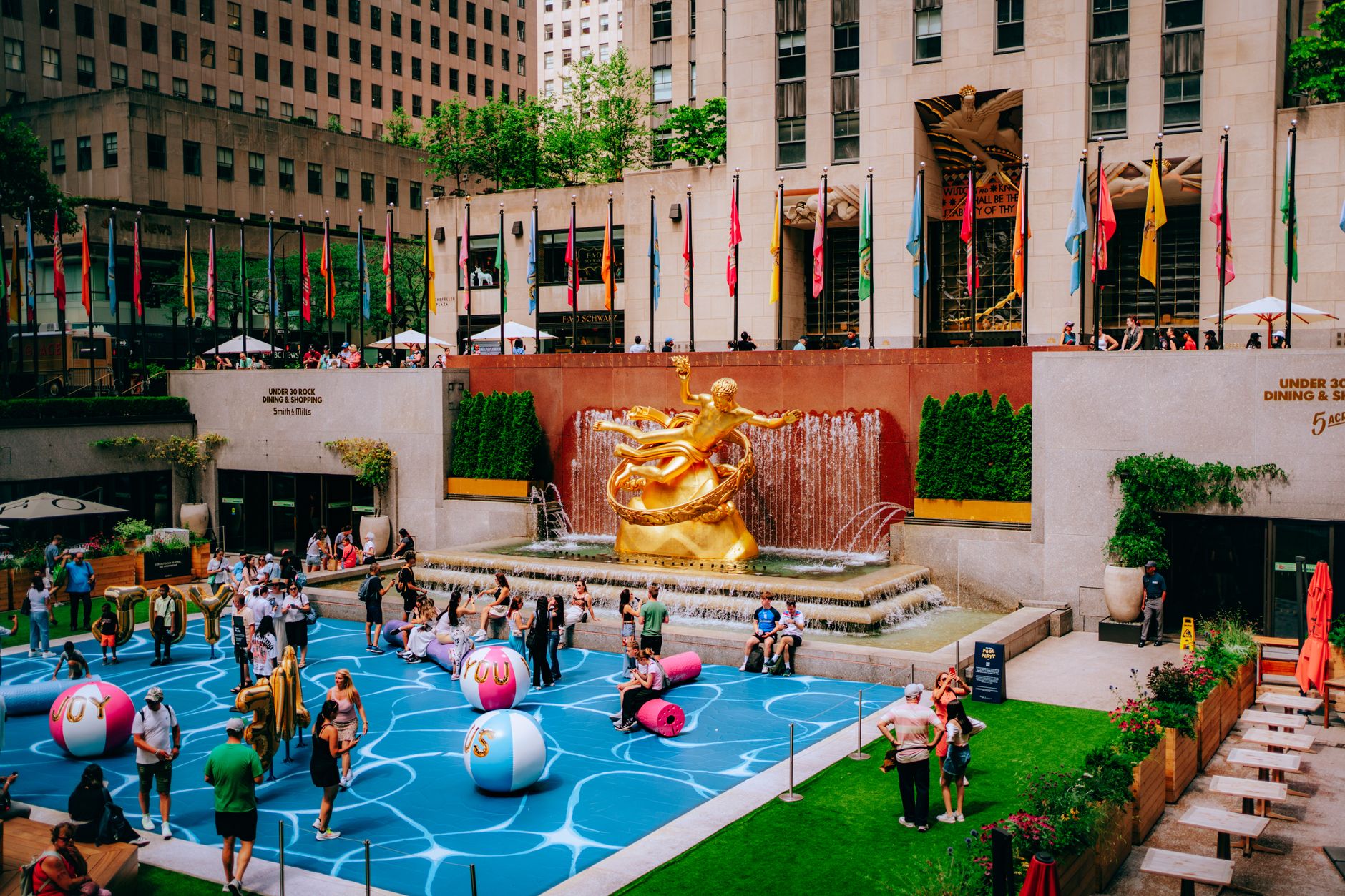
The choice of Rockefeller Center follows an equally clear logic. During Fashion Week, Manhattan is packed with presentations aimed at press, buyers, and industry insiders; installing a monumental bag in one of the city's most visited and photographed locations allows Gap to speak simultaneously to that circuit and to the general public. The plaza offers a symbolic scale that a boutique or showroom could hardly replicate.
Krakoff pointed to the lively and monumental character of the location as the very reason for the choice. For Gap, which has built its history on its relationship with American pop culture, Rockefeller Center also makes it possible to set the debut in a recognizable context without having to build an exclusive brand mythology from scratch. The temporary monument serves as a physical beacon, a photo opportunity, and an invitation to enter the retail space.
The transition from the street to the point of sale is central. Large installations can generate attention, but their commercial effectiveness depends on the ability to translate that image into an understandable and accessible product. Here, continuity is explicit: the oversized tote replicates the purchasable model, while the pop-up adds craftsmanship and variants that heighten the feeling of participating in a limited launch. The website gap.com, live since Tuesday, also ensures the initiative is not confined exclusively to those in New York.
The real test comes after Fashion Week
GapBag enters a crowded category, where the denim tote is already a widespread format and where the attention generated by a collaboration or event can fade as quickly as it peaks. The presence of two artist editions and customization offers a debut in tune with the cultural moment, but it does not replace the need to establish a line capable of enduring over time. The most concrete data point, for now, is the initial response reported by the team: several styles are close to selling out, and a restock is expected in North America.
For the brand, the next step will be demonstrating that the bag can become a permanent fixture of its lineup, with models, colors, and use occasions that do not rely solely on the launch activation. For the public, the appeal lies in watching a mass-market brand disciplinedly leverage experiential mechanics and scarcity without abandoning its core identity. The giant tote at Rockefeller Center is the most visible gesture; the true measure of the project will be GapBag's ability to remain in wardrobes, rather than just in Fashion Week imagery.