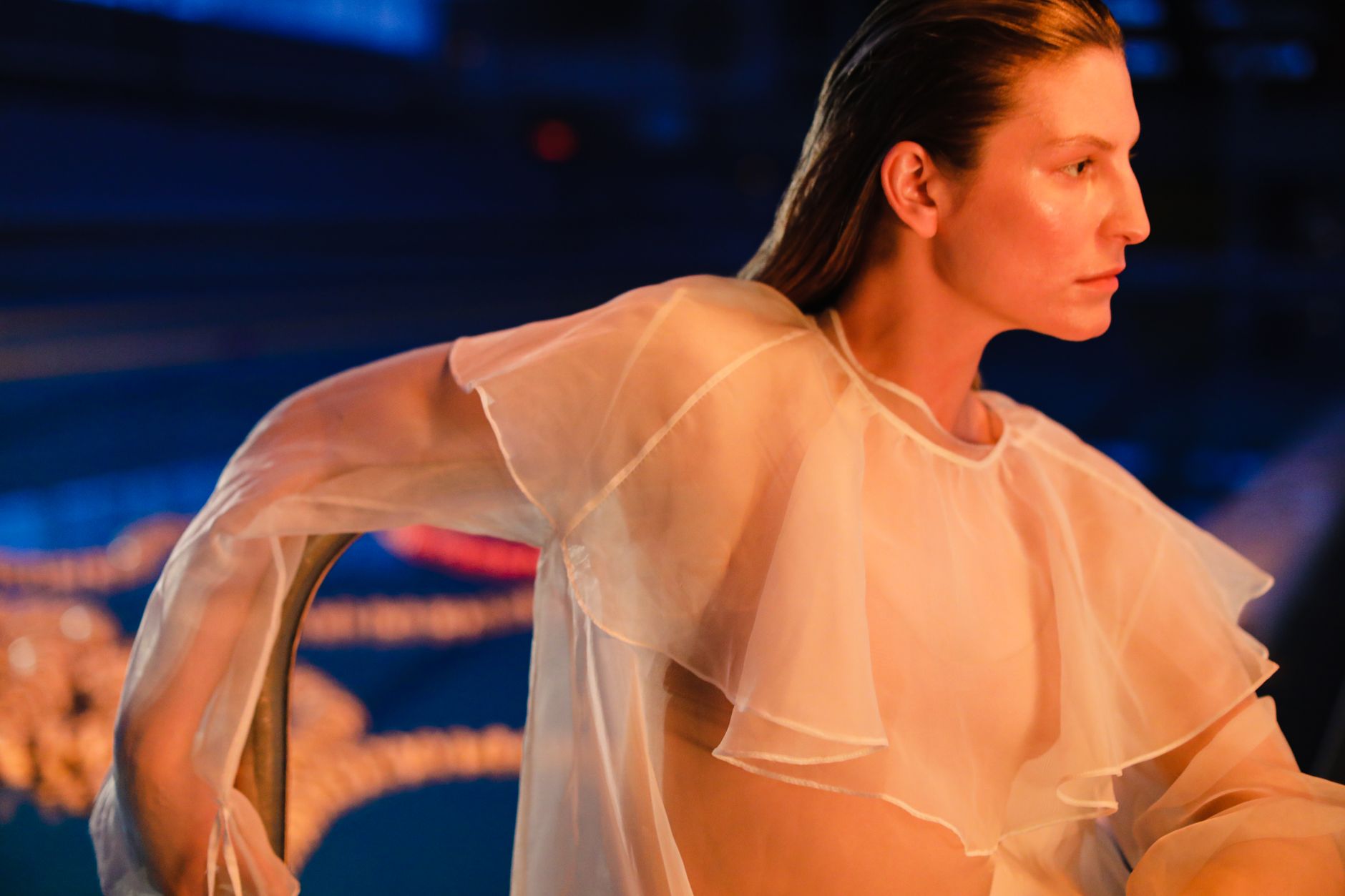
For its twenty-fifth anniversary, Libertine chose not to turn the runway into an exercise in nostalgia or a statement of refoundation. At New York Fashion Week, hosted in the spaces of the National Arts Club in Gramercy Park, Johnson Hartig presented Spring 2027 by adhering to the codes that have made the brand recognizable: decorated surfaces, deliberately heterogeneous pairings, botanical references, and a predilection for ornamentation that spans both women's and men's wardrobes.
The milestone, celebrated before an audience of clients and brand supporters, carried tangible weight. Hartig noted how rare it is in today's fashion industry to reach a quarter of a century while remaining an independent, profitable label. It is a fact that provides the key to reading the show: the goal was not to prove it could become another brand, but to reaffirm that a distinct identity can still form an industrial strategy, as long as it is consistently nurtured.
An anniversary told through the product
The Spring 2027 collection showcased a repertoire that was rich yet familiar for Libertine. Looks in shades of ivory and white crossed by bold stripes made an appearance, alongside Bloomsbury-inspired patchwork on linen and prints reminiscent of paint marks and splatters on drop cloths. Alongside these elements, the designer sent down the runway suits adorned with large sequin butterflies and a hand-embroidered topiary coat, featuring double boxwood hedges set in urns inspired by the gardens of Versailles.
The common thread tying materials, prints, and embellishments together is Hartig's ability to construct garments by treating them as narrative surfaces. The garden, flowers, and decorative imagery do not serve here as a closed seasonal theme, but as a vocabulary that the brand continues to evolve. The variety of inspirations does not erase the signature style; on the contrary, it makes it instantly recognizable, even as the collection shifts from linen to tailoring, from everyday wear to eveningwear.
In a context where many fashion houses mark anniversaries with commemorative capsule collections, rebrandings, or literal re-editions, Libertine focused its message on the final look. A basketball-inspired jersey and pair of shorts bore the number 25 rendered in red sequins, while “Happy Birthday” played throughout the venue. A direct, almost playful gesture that left the collection to tell the rest of the story.
Fidelity to brand codes as an economic choice
Fashion tends to view change as an ongoing test of relevance. For an independent brand, however, shifting direction can also mean weakening the relationship built with its audience. Libertine's runway show highlights another possibility: continuity can be a discipline rather than a compromise. The clientele packing the National Arts Club wore the brand's heavily embellished dresses, jackets, and trousers—a visual cue of how deeply the product has integrated into the wardrobe of an established community, rather than merely circulating as runway imagery.
That community matters because Libertine’s model is not built on neutrality, nor on the promise of garments designed to appeal indiscriminately to everyone. Sequins, feathers, and artisanal embroidery demand a customer willing to wear an outfit as an aesthetic statement. It is a more niche position compared to mass luxury, but one that can prove resilient when customers recognize a consistent language in the brand and return to it season after season.
The element of independence is particularly significant at a time when the industry is dominated by conglomerates, growth pressures, and ever-accelerating creative cycles. Remaining profitable for 25 years without softening the most polarizing elements of its offering suggests that originality—when backed by a loyal customer base—still has room to thrive outside the logic of standardization. It is not an automatically replicable formula: such a well-defined aesthetic relies heavily on the continuity of its creator's vision and the precision with which it is translated into product.
Between maximalism and recognizability
Spring 2027 steers clear of the idea that minimalism is the only viable contemporary language. Libertine does the exact opposite: it piles on motifs, materials, and references, yet finds coherence through ornamentation. The coat with the topiary motif, the butterflies across the jackets, and the atelier prints do not aim for understatement; instead, they define an approach to dressing that prioritises storytelling, perceived craftsmanship, and visual impact.
This approach also carries implications for the brand's positioning. In a market saturated with capsule collections and micro-trends, a garment easily attributed to a label can hold far greater value than an offering perfectly aligned with the mood of the moment yet interchangeable. Libertine's identity lies precisely in this recognisability: those seeking an understated silhouette or quiet luxury will hardly find what they are looking for, while those in search of memorable garments find a proposition that refuses to dilute its character.
The challenge of the coming years naturally remains. An anniversary confirms longevity, but does not guarantee the future, and Hartig wryly dismissed questions about the next quarter of a century. For now, however, the collection sends a clear signal: Libertine intends to move forward without disowning its own design vocabulary. The direction is not that of an aesthetic revolution, but an internal evolution forged through new combinations, new imagery, and the same meticulous attention to decorative detail.
Ultimately, the 25th-anniversary celebration served less as a retrospective and more as a statement of intent. Rather than seeking legitimacy through reinvention, Hartig demonstrated that a brand's longevity can come from protecting what makes it distinct. For Libertine, that core remains rooted in craftsmanship, humour, imaginary gardens, and clothes designed to command space—both in the room and in the imagination of those who wear them.


