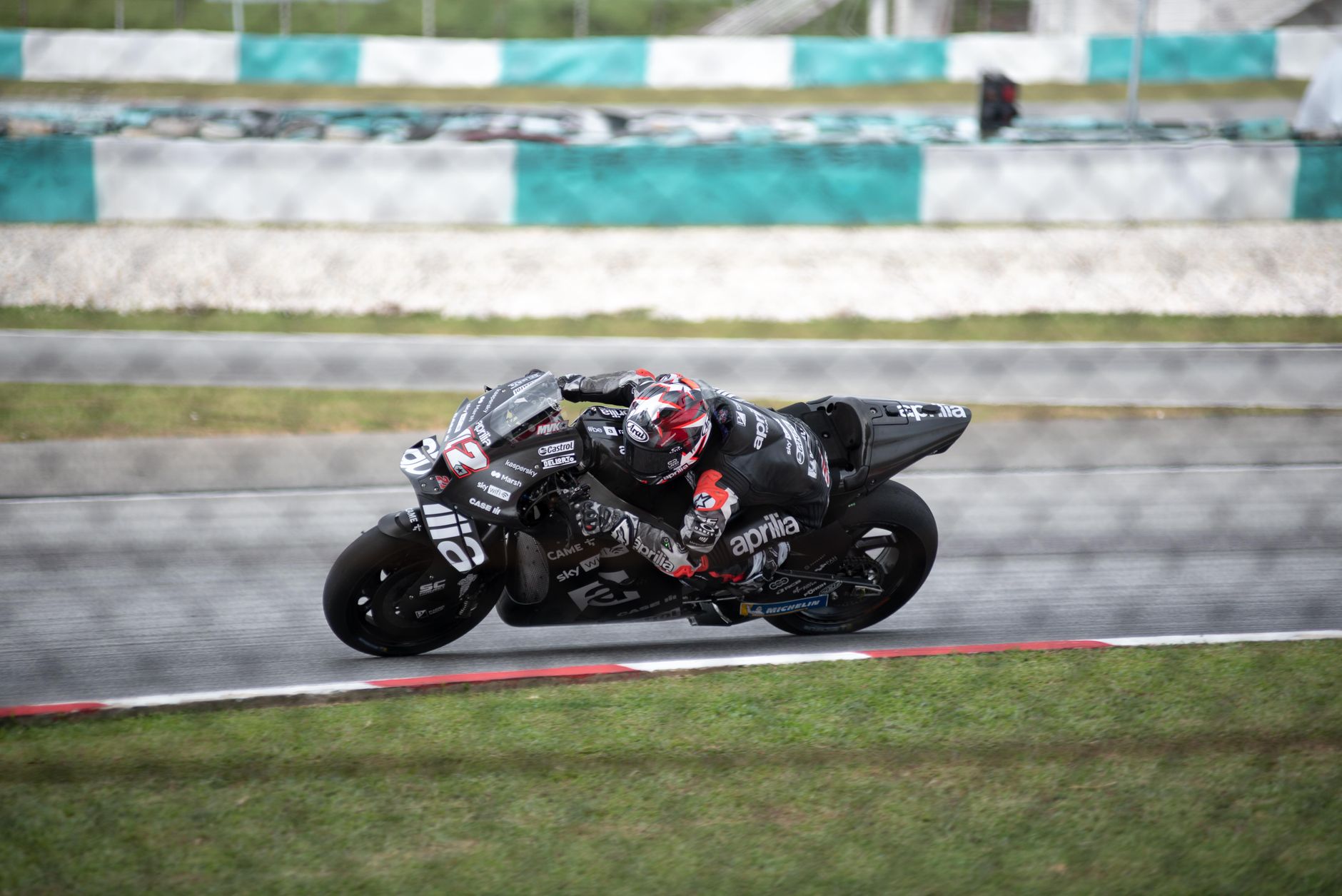
Jorge Martín arrives at the Gran Premio di San Marino as the leader of the 2026 MotoGP World Championship, but without turning his position in the standings into an excuse. On the eve of the Misano round, the Aprilia rider pointed to Marc Márquez and Marco Bezzecchi as the two current benchmarks in terms of speed, acknowledging they hold a slight edge. It is an assessment that matters above all for how it reshapes his race priorities: defending the championship lead without pursuing marginal gains on track at all costs.
Martín leads the standings with a 19-point advantage over the Ducati rider and 24 over Bezzecchi, his teammate at Aprilia. A useful gap, but too narrow to allow for defensive calculations all the way to the end of the season. In a championship where a crash or an injury can alter the balance of the title fight within days, risk management becomes an integral part of performance. The Spaniard’s message is clear: he is not willing to get hurt just to gain something.
This does not mean giving up on competing. Martín has not announced a cautious race in the most passive sense of the term, nor has he downscaled his ambition to win. However, he has drawn a clear line between productive aggression and reckless gambling. Acknowledging that Márquez and Bezzecchi may have an edge at this stage also prevents a distorted reading of the weekend: when the opponents’ pace is superior, attempting to compensate solely by riding on the limit can carry a far higher cost than a few points dropped along the way.
The leader cannot chase every duel
MotoGP does not merely reward whoever wins the most Sundays, but whoever maintains consistency across a calendar exposed to technical variables, track conditions, and crashes. For a championship leader, assessing a manoeuvre is fundamentally different from a pursuer’s perspective. A chasing rider may be driven to attempt an overtake or the perfect lap even under unfavourable conditions; the rider in front must balance two imperatives: not conceding ground needlessly, and not handing rivals a turnaround caused by scoring a zero.
The 19 points over Márquez and 24 over Bezzecchi do not yet define a safety buffer. However, they are enough to make a selective approach rational whenever the risk outweighs the potential return. Martín seems intent on building his weekend around this exact criterion. Moreover, referencing two rivals rather than just one shows how crowded the top of the championship is: the pressure comes not only from Márquez's Ducati, but also from the other Aprilia of Bezzecchi.
Bezzecchi's presence introduces a delicate factor into the team's internal management. The two share facilities and industrial objectives, but on track they are direct rivals for the title. Martín has stated that he currently enjoys a good relationship with both named rivals, a detail that can help keep the battle within clear sporting limits. Yet cordiality does not erase competition: every result from Bezzecchi reduces the leader's margin, and every performance from Martín defines the boundaries within which his teammate can still attack the championship.
Misano as a test of the Aprilia method
The GP di San Marino thus becomes an important test not only for Martín's championship position, but for the weight of Aprilia in the central phase of the title fight. Having two riders in the top positions turns the squad into a central player in the championship, offering obvious advantages in terms of competitiveness and visibility, but also greater complexity in managing expectations. There is no room for declared team orders when both riders have a tangible chance to fight for the result and the leader holds a margin that remains surmountable.
For the MotoGP industry, the contest among Martín, Márquez, and Bezzecchi places three distinct, intertwined interests front and center: the defense of Aprilia's leadership, the pressure exerted by Ducati through Márquez, and Bezzecchi's rise as an internal challenger. The races leading up to the end of a season impact reputation, commercial narrative, and the teams' ability to keep their competitive environment stable. On an immediate level, however, the priority remains strictly sporting: bringing bike and rider across the finish line with the best possible result.
Martín does not hide the strength of his rivals, and this choice can have a concrete impact on his approach to on-track work. Acknowledging a slight advantage for others does not mean handing them the weekend; rather, it means starting from a realistic assessment, focusing on the margins that the bike and the conditions will offer session after session. In MotoGP, the pecking order can shift rapidly between practice, qualifying, the Sprint, and the main race. A Thursday statement does not determine Sunday's finishing order, but it clarifies the level of awareness with which the leader approaches the event.
The value of an injury-free season
The most significant part of Martín's remarks concerns health. The ability to avoid injuries is not a secondary matter in a title-contending season: it is a prerequisite for capitalizing on an established advantage. A crash that forces a rider to miss races, or that compromises physical fitness, carries disproportionate weight compared to a single sub-optimal finish. Hence the decision not to turn every fraction of a second or every potential overtake into an absolute objective.
Caution, in this case, should not be confused with a lack of ambition. Martín remains ahead of two riders he considers particularly competitive, and he knows that defending the top spot in the standings will require results, not just race management. The difference lies in the threshold beyond which risk is no longer justified. In a tight championship, a second place or a solid points finish can carry greater strategic weight than a victory pursued beyond the limit.
The upcoming sessions at Misano will reveal whether the leader's assessment of the competitive balance holds true. If Márquez and Bezzecchi do indeed show superior pace, Martín will be called upon to maximize what his Aprilia can deliver without exposing himself to costly mistakes. If, on the other hand, the weekend's work narrows that gap, the leader will be able to fight for the top spots with greater freedom. In either case, the direction is already clear: defending the World Championship also means choosing when not to push.