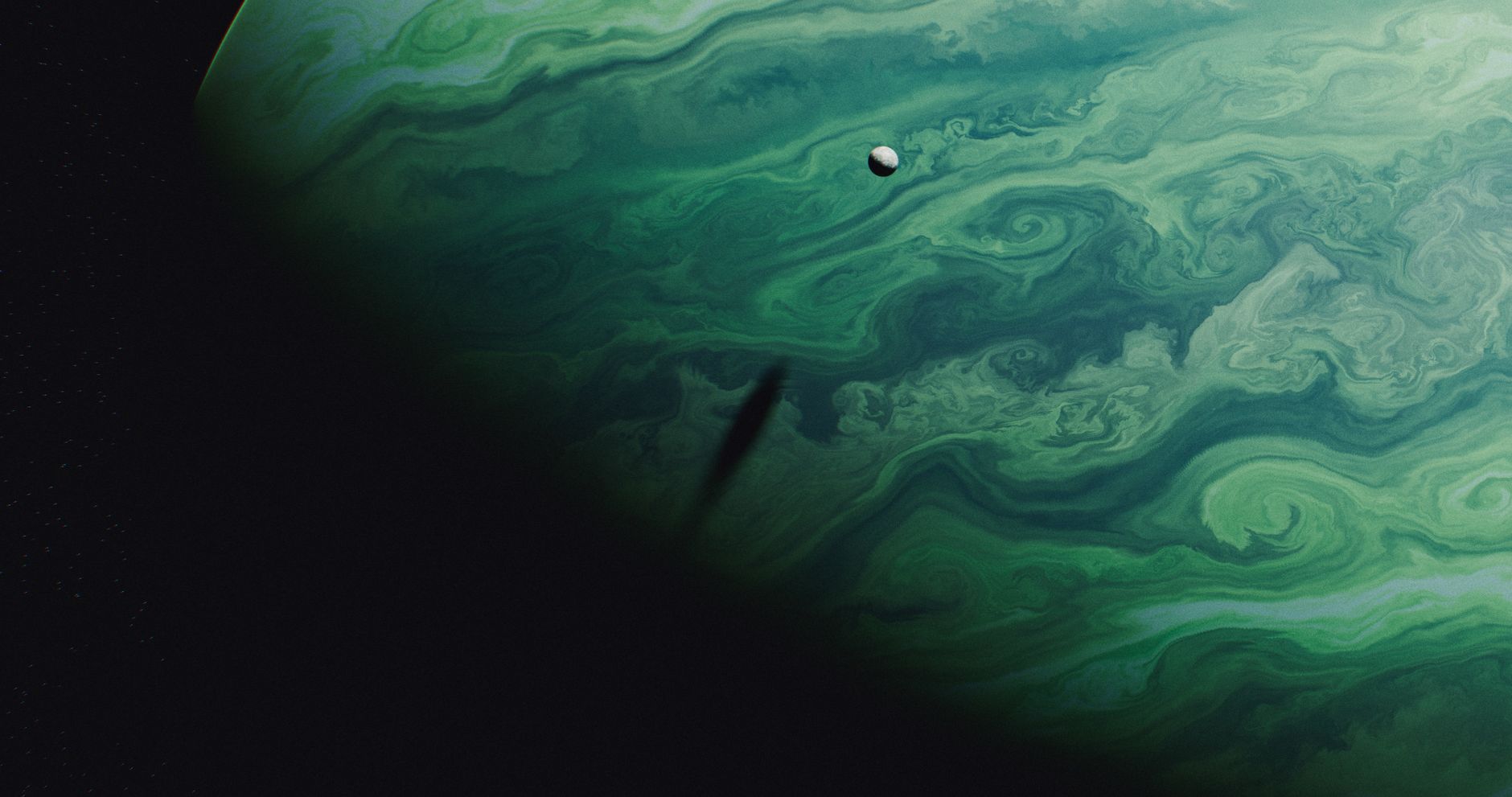
No Man’s Sky has turned ten, and Hello Games has chosen to celebrate the anniversary by addressing the part that, paradoxically, had remained the most unchanged since launch: space. On September 9, the British studio released Cosmos, a free 7.0 update available on PC, PlayStation 4 and 5, Xbox One and Series, Switch and Switch 2, Mac, VR headsets, and Game Pass. The most prominent new feature is the ability to own and build space stations, but the package includes a much broader overhaul of navigation, points of interest, and interplanetary activities.
It is difficult to separate this news from the game’s history. No Man’s Sky launched in 2016 under enormous pressure and with expectations that the initial product failed to meet. Hello Games chose not to abandon it, continuing to release free updates for a decade. Cosmos is the fortieth major update and arrives as a kind of definitive statement on that model: a game sold once that continues to receive substantial content without paid expansions.
Space finally becomes a place, not just an interval
Sean Murray, the studio’s founder, explained that the space in No Man’s Sky had not truly been radically rethought since launch. For a title almost always defined as a “space game”, it is a notable contradiction. Until now, many major activities took place on planets or inside relatively standardized structures. Cosmos instead aims to make travel between worlds an environment with its own density.
The new local star map displays celestial bodies, stations, and new points of interest. Among these are asteroid belts, inhabited or infested outposts, procedurally generated derelicts, debris fields, and platforms built in space. There is even the option to head toward a system’s star—an action that previously held primarily scenic value.
The most requested feature was owning a station
Hello Games presents station building as one of the community’s most frequent requests. Players can claim and customize structures, build orbital bases, and establish permanent presence networks off-planet. It is a change that alters the social function of the universe: instead of merely traversing it, players can leave behind infrastructure.
This idea connects to the new alliances. Murray spoke of potentially massive communities, with thousands and prospectively tens of thousands of players capable of collaborating around stations and territories. No Man’s Sky is not becoming a traditional MMO, but it is shifting toward a more ambitious social scale. The procedural universe was already enormous; Cosmos attempts to give it more persistent gathering points.
Wrecks become dangerous mines
Among the most tangible additions are the so-called space hulks, wrecks that can be explored and dismantled. Players have tools like a gravity gun and a ship-mounted tractor beam at their disposal to salvage materials. The risk is that over-extraction can destabilize the structure to the point of making it explode. It is a minor mechanic compared to station building, but it illustrates the effort to turn space into an environment with physical interactions and resources, rather than just a transit screen.
This philosophy runs throughout the update: more objects, more reasons to stop, and more chances to discover something that wasn't planned on the original flight path. In an exploration-based game, the density of decisions matters just as much as the size of the world.
The anniversary expedition chronicles ten years of development
Cosmos also includes the “Our Journey Continues” expedition. Each milestone represents one of the 40 major updates released since 2016, complete with features, developer commentary, and a kind of interactive archive of the game's transformation. It is an unusual element because it turns the development process into part of the gameplay experience.
The story of No Man’s Sky has become almost inseparable from the game itself. Many players buying it today encounter a radically different product from the one launched ten years ago. The expedition turns this journey into content and allows the studio to showcase how individual additions—bases, multiplayer, fleets, VR, settlements—have progressively altered the overall architecture.
The business model remains an anomaly
In an industry that monetizes through battle passes, expansions, microtransactions, and subscriptions, Hello Games continues to release updates without paid DLC. The sustainability of the model depends on ongoing sales of the game on new platforms and the continuous expansion of its audience. Every major update also becomes a new indirect commercial campaign: it brings the title back to digital storefronts, news coverage, and videos.
Cosmos is indeed launching on an exceptional range of hardware, including Switch 2. This cross-platform presence allows the studio to sell the same universe to successive generations of users without fragmenting the player base through mandatory expansions. It is a strategy that cannot be automatically replicated by every studio, but No Man’s Sky proves that a live game can be sustained even without turning every update into a new transaction.
Part of the technology lays the groundwork for Light No Fire
Hello Games is simultaneously working on Light No Fire, the new project set on an Earth-sized fantasy planet. Murray explained that some of the technologies tested in No Man’s Sky, including those related to large communities and rendering, are also useful for the upcoming game. Cosmos thus becomes both an update and a testing ground.
This is a rare advantage for an independent studio: having a mature product with millions of users in which to test systems destined for the future. Naturally, the two experiences will remain distinct, but the infrastructure built over ten years can reduce the technical risk of the next project.
The most important lesson is continuity
No Man’s Sky did not become what it is today through a single relaunch. It did so by accumulating changes over ten years. Cosmos shows how much this continuity can transform a digital product: the very same initial purchase has progressively become a game of exploration, building, management, cooperation, VR, and now space colonization.
Not all additions carry the same weight, and not every player will love the growing complexity. But update 7.0 is significant news because it touches the core of the experience and arrives at a time when many other live services are shut down after just a few years if they fail to meet immediate targets. Hello Games, on the other hand, continues to treat a 2016 game as a platform that is still in development.
Ten years ago, the question was whether No Man’s Sky could deliver on its launch promises. In 2026, the question has become almost the opposite: how much further can a game expand before turning into something its creators hadn’t even imagined at the start. Cosmos tries to answer by making space itself a new home.