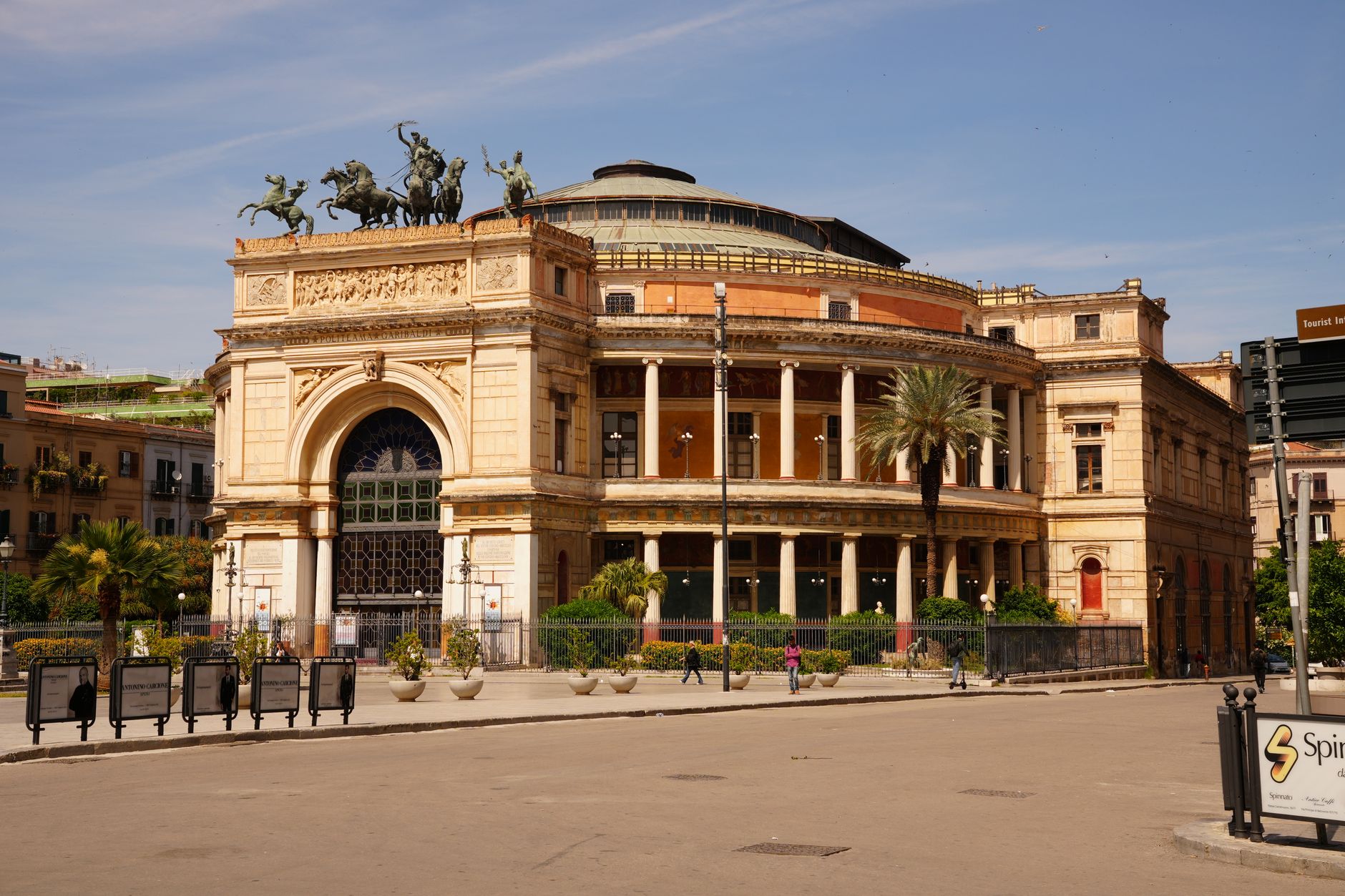
Teatro Dante turns its lights back on in Palermo on October 31, after years of closure, with a project that significantly shifts its operational scope. The historic venue in piazza Lolli is not merely reopening as a space for drama and music: management entrusted to the Random group transforms it into an all-day destination where cultural programming coexists with a literary café, a restaurant, and a rooftop bar.
The opening, scheduled for 7:30 PM with the event titled La Première, is dedicated to Brendan Dine, a British partner of Random who passed away prematurely. For the Sicilian group, active across entertainment and hospitality, the reopening marks the start of a management approach designed to bring together different audiences, schedules, and consumption habits: those who drop in for a meeting or to work over coffee during the day, those booking dinner, those attending an evening performance, and those choosing the rooftop as a gathering spot.
It is a model now familiar in cities where cultural spaces seek steadier revenue streams than ticket sales alone can provide. In the case of the Dante, however, the project revives a building that holds a distinct place in Palermo's performing arts history and has been protected by the Regione Siciliana since 2017. The core issue, then, is not simply about a new food and beverage opening: it is an attempt to restore economic sustainability and a daily presence to a historic venue.
A venue with a history that predates the new format
Before becoming a theater, the Dante began life as a cinema. The conversion took place in the 1977–1978 season, when Cooperativa teatro studio uno, led by Aldo Morgante, turned it into a stage primarily dedicated to comedy and light theater. In subsequent years, the hall hosted, among others, Otello starring Enrico Maria Salerno and Na sera de maggio with Beniamino and Rosalia Maggio; it was also home to one of Eduardo De Filippo's final directorial productions.
This layering explains why the reopening is significant beyond the inaugural event. Il Dante is not being presented as a shell to be completely repurposed, but as a venue whose performance function remains central. The hall, with a capacity of over 700 people and seating that can be reconfigured depending on the schedule, will host jazz concerts, stand-up comedy, conferences, panel discussions, dinner shows, and private events. The announced variety expands the potential schedule and, above all, allows the venue to operate with formats capable of generating footfall across different time slots.
For a theater facility, having a complementary offering can directly impact its ability to stay active outside showtimes. The literary café caters to daytime hours; the restaurant can be tied to the evening program or thrive on its own standalone demand; the rooftop bar adds an amenity closely tied to the neighborhood and piazza Lolli. These are distinct activities, each with its own audience and operational dynamics, yet all housed under a single brand identity.
Food as experience infrastructure
In Il Dante's new setup, the food component does not appear as a marginal addition to the auditorium. The café, restaurant, and rooftop all help shape the kind of extended stay the venue aims to provide. The stated goal of Mariangela Giambrone, director of the Random group, is to create a space where culture, entertainment, and socializing can coexist from morning until late into the night.
This approach also alters the relationship between audience and venue. Visitors are no longer just expected to arrive shortly before showtime and exit the building once the event concludes: they can arrive earlier or linger longer. For the operators, diversifying revenue across ticketing, hospitality, and food and beverage reduces reliance on a single product. For the neighborhood, meanwhile, the bet is on revitalizing a venue capable of driving traffic on a more regular basis.
The format also has a complex operational side. Scheduling shows, managing a restaurant, coordinating bar service, and hosting private events requires foot traffic, schedules, and spaces to be compatible. Dining operations must work both in connection with scheduled performances and during times when there are no shows; likewise, a rooftop bar must strike a balance between its own appeal and the theater's identity. The source does not yet disclose menus, chefs, pricing, opening hours, or reservation policies: these are elements that will shape the project's concrete form in the coming months.
The very absence, for now, of details regarding the dining offering suggests viewing the reopening for what it is: the launch of a new hospitality infrastructure, rather than the debut of a restaurant with a specific culinary signature. The project's value lies in combining functions and enabling a protected cultural heritage asset to work alongside commercial activities targeting diverse audiences.
A test for the hybrid venue model
The revival of the Dante is part of a broader trend affecting many auditoriums, former cinemas, and entertainment venues: to remain economically viable, these spaces complement their programming with services designed to increase space utilization and visit frequency. This is no automatic guarantee of success. The strength of such a project depends on the quality of the programming, the distinctiveness of the food offering, hospitality management, and the ability to prevent one function from dominating to the point of hollowing out the others.
In Palermo, the starting point is significant: a building with an established theatrical history is reopening, not a venue built from scratch around consumption. Regional heritage protection also mandates respect for the site's value and cultural continuity. Random will therefore have to demonstrate that expanding the offering does not reduce the theater to a mere backdrop, but actively supports its operations.
After La Première, the real test will be establishing a regular schedule and a credible everyday rhythm. If the literary café, restaurant, and rooftop manage to integrate with concerts, talks, and theatre without fragmenting the experience, the Dante could once again become a civic landmark with a broader role than in the past. For Palermo's dining scene, it will also be a case to watch: not so much for a fully defined culinary novelty, but for the way hospitality and culture can share a historic space and make it lived-in once again.