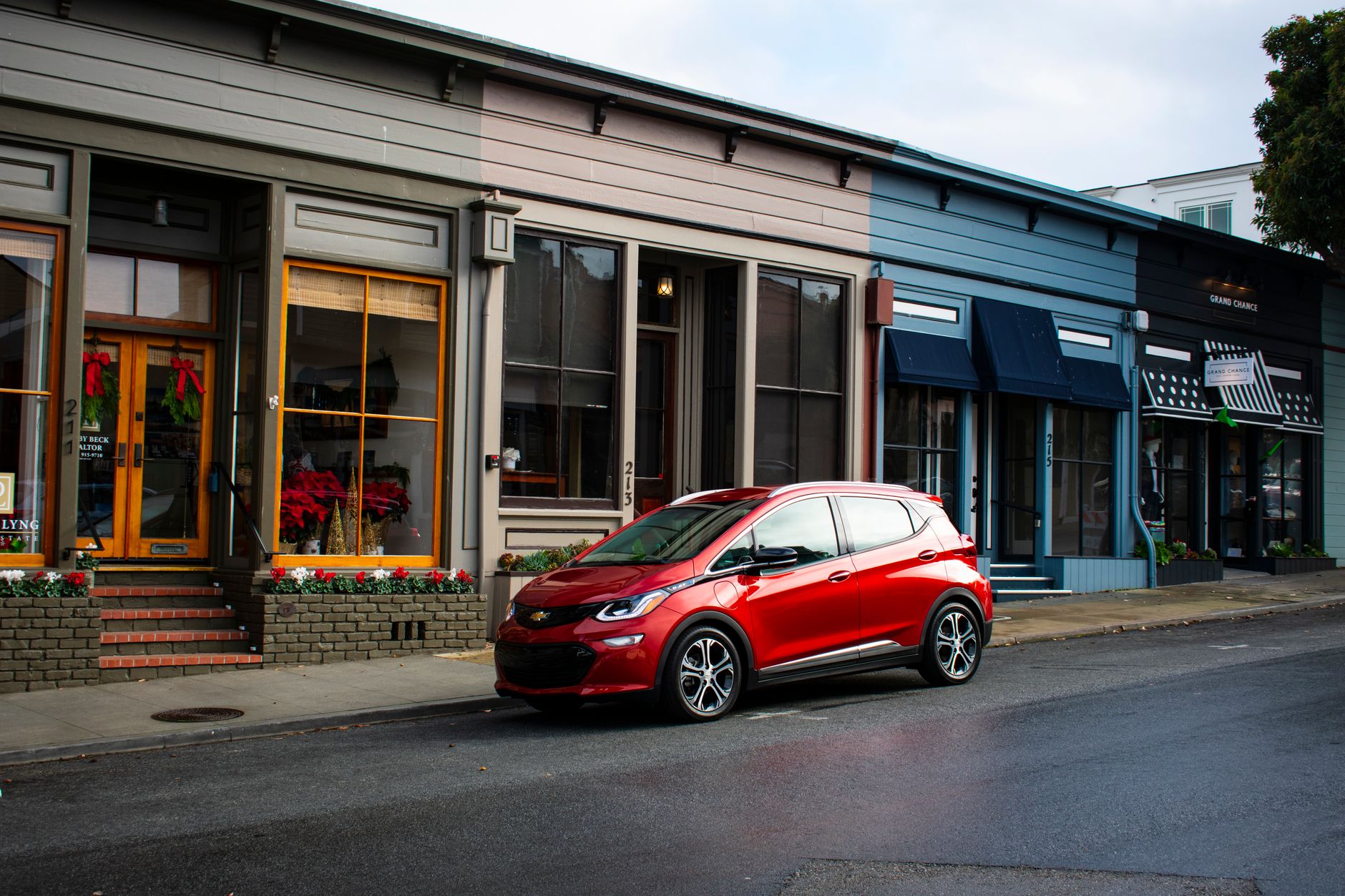
The Chevrolet Bolt returns to the US market in a different phase from that of its first life. GM's compact EV is no longer just one of the few affordable options available: in 2027, it must contend with a much broader market offering, starting with the Tesla Model 3, which remains one of the most recognizable benchmarks for battery-powered cars in the United States. The comparison between the new Bolt RS and the Model 3 Standard RWD highlights just how much the segment has changed: affordability no longer depends solely on the base sticker price, but on the value the car delivers once trims and options are factored in.
Indeed, both vehicles tested by MotorTrend come close to the $40,000 mark. The Bolt RS starts at $32,995, while the Model 3 Standard RWD begins at $38,630; in the tested configuration, the gap narrows to just $690 in favor of the Chevrolet. It is a figure that significantly alters the nature of the showdown. If the Bolt is chosen in its top-tier trim, Tesla no longer seems out of reach in terms of price, allowing it to leverage its performance, range, efficiency, and more sophisticated engineering approach far more effectively.
Yet an important distinction remains for budget-conscious buyers. Chevrolet will keep a non-RS Bolt in its catalog with an entry-level price of $28,995. That figure still places the hatchback in territory that Tesla does not cover with the Model 3. The RS, on the other hand, demonstrates how stepping up to a flashier, more feature-packed trim can rapidly erode the initial cost advantage of a model designed for the mass market.
Two opposing ideas of an everyday EV
The Bolt retains a conventional layout, and this is arguably one of its strongest arguments. It is a compact hatchback with an elevated driving feel, good outward visibility, a traditional dashboard, and controls that require no familiarity with a specific digital ecosystem. For many drivers transitioning from a combustion-powered vehicle, the switch is seamless: they are greeted by recognizable instruments and functions without having to learn a whole new operating manual just to drive the car.
The RS's cabin doesn't hide the need to keep costs down. Plastics dominate, but the grey-and-black color scheme and textures keep it from feeling neglected. Most importantly, Chevrolet makes good use of space with open compartments, storage pockets, and straightforward solutions tailored to everyday needs. In a compact EV, where the pursuit of aesthetic minimalism often compromises practicality, it's a choice that aligns well with the Bolt's purpose.
The Model 3 takes the opposite approach. Its body retains a now-familiar shape despite the 2024 refresh, but the interior remains instantly recognizable: almost everything revolves around the central 15.4-inch display, which is larger than Chevrolet’s 11.3-inch unit. The panoramic glass roof also enhances brightness and the sense of space for rear passengers.
Tesla, too, in the Standard RWD variant, reveals a few entry-level compromises. Fabric upholstery and unpretentious materials serve as reminders that this isn't a premium trim. However, the test unit showed none of the panel misalignments or noticeable build defects that plagued the reputation of some earlier Teslas. The result is a more spartan environment than the Bolt's, but also one that is more coherent in its digital product ethos and visual cleanliness.
The flip side is well known: touchscreen-managed functions and unconventional controls require an adjustment period, not just for the driver but for passengers as well. Chevrolet, on the other hand, prioritizes familiarity. This is no minor distinction, as ergonomics can matter just as much as an acceleration figure or an entry on the price sheet for vehicles aimed at a mainstream audience.
Tesla's edge emerges the moment you accelerate
Dynamically, the Model 3's advantage is clear-cut. Compared to the Bolt, the Tesla boasts an extra 76 hp and 190 lb-ft of torque. In instrumented testing, it hits 60 mph in 5.4 seconds, versus 6.7 seconds for the Chevrolet: a 1.3-second gap that is felt both off the line and during passing maneuvers. From 45 to 65 mph, the Model 3 takes 2.0 seconds, whereas the Bolt requires 3.0.
The Standard RWD does not try to pass itself off as a sports car. The initial pull is progressive, and there is no Sport mode or array of performance settings to involve the driver in configuring the setup. Yet the acceleration remains consistent past 60 mph and even at speeds above 80 mph, offering a useful reserve for highway driving. It is an almost impersonal efficiency, but a concrete one.
The Bolt RS features a Sport mode, but fails to tip the scales. During testing, achieving the best acceleration time required overlapping the brake and throttle; furthermore, the initial launch feels less sharp than the 6.7-second time would suggest. This does not mean it is inadequate for real-world traffic: once underway, it provides sufficient performance for everyday use. Quite simply, next to the Model 3, it feels less responsive and less punchy.
Handling and brakes: the platform still matters
Tesla's superiority continues through the corners. Rear-wheel drive and a suspension layout with front control arms and a rear multilink contribute to a more stable, composed response. The Model 3 delivered more grip and a faster time on the figure-eight course, even without conveying that mechanical character typically associated with a rear-wheel-drive sedan.
Steering, in both cases, is not a strong suit: MotorTrend notes minimal communication and limited feedback. The difference lies in the vehicle's overall cohesion. The Tesla feels more planted as a whole, while the Bolt prioritizes agility and light responses. The Chevrolet tends slightly toward understeer, but it can prove even more fun than expected given its positioning and compact body.
For the market, the comparison carries more weight than a verdict between two models. It shows that the affordable electric segment in the United States is becoming stratified. A lower sticker price remains essential, and the base Bolt's 28,995 dollars send a clear message from GM. But when customers move up to higher trims, the conversation quickly shifts to real-world range, performance, ride quality, software, and overall product perception.
In this segment, the Model 3 Standard RWD manages to feel like a complete car even without the typical elements of more expensive Tesla variants. The Bolt RS instead offers a pragmatic alternative, more intuitive to use and true to the logic of the compact hatchback. The choice, then, is not just between a screen and physical buttons, or between a sedan and a tailgate. It is between two ways of making the mass-market EV credible: Tesla focuses on efficiency, digital integration, and dynamics; Chevrolet on the entry point, functionality, and immediacy. In the direct RS comparison, however, the close pricing makes it harder for the Bolt to offset the Model 3’s advantages.


