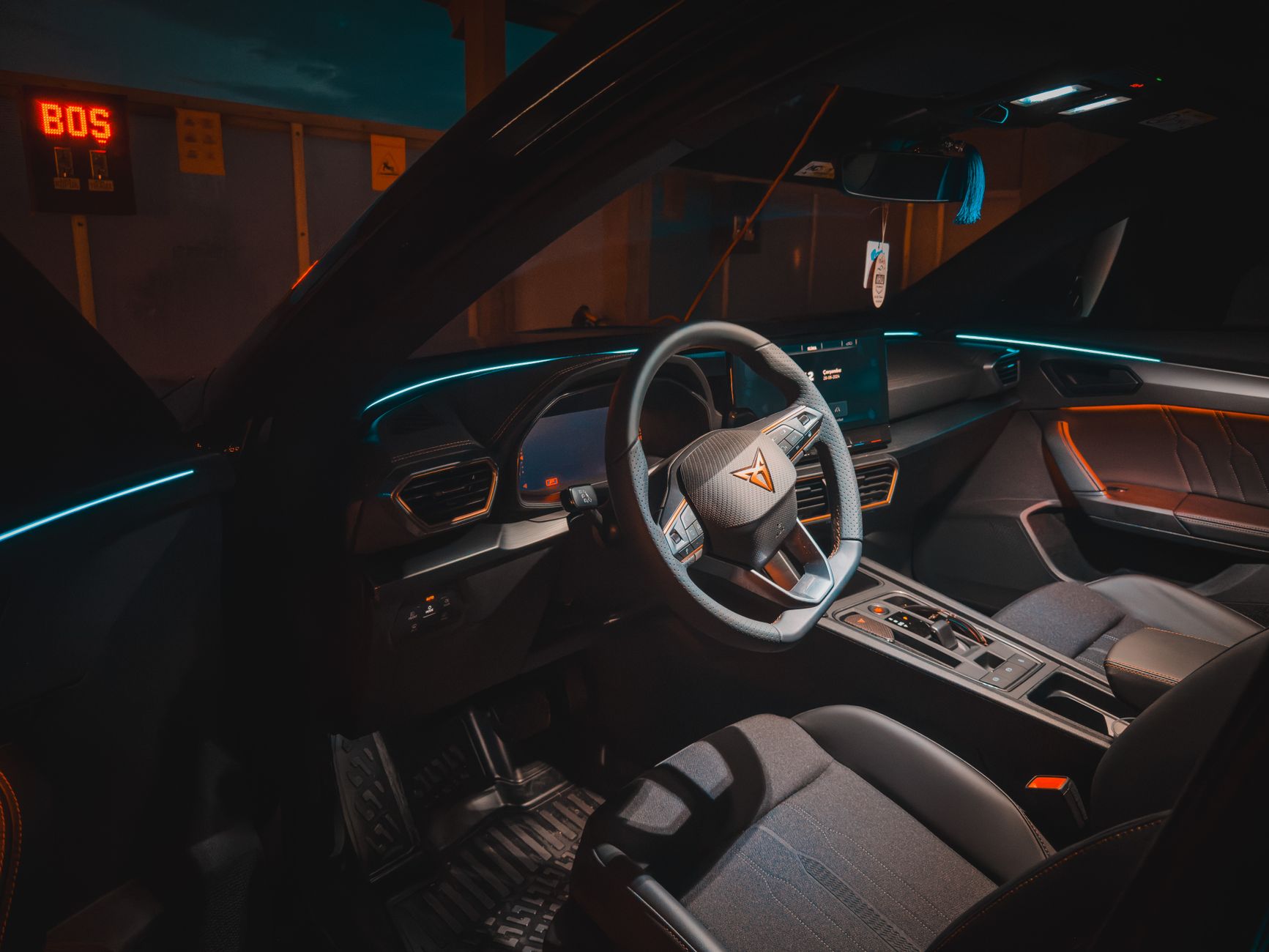
For decades, a car's interior was primarily a place to drive from. Steering wheel, gear shift, instrumentation, radio, a few buttons. The rest was comfort. Today, that relationship has almost flipped: the cabin has become a digital platform, an entertainment space, and a design object that needs to impress before you even set off.
Panoramic screens, ambient lighting, massaging seats, voice assistants, increasingly sophisticated sound systems, touch surfaces, and customizable interfaces are transforming how we perceive a car's value. Often, we no longer choose based solely on how it drives, but on how it makes us feel when standing still.
The dashboard has become a homepage
A significant part of this transformation stems from software. Modern cars must manage navigation, climate control, music, phone calls, cameras, driver assistance, and an ever-growing list of connected features. The screen has become the natural gateway to all of this.
The problem arises when the digital interface replaces controls that already worked remarkably well. Adjusting the temperature with a knob is an almost automatic action. Doing so by navigating a menu can demand far more attention. The idea of aesthetic “cleanliness” thus risks running counter to ease of use.
True automotive luxury shouldn't be about having more features. It should be about being able to use them without thinking.
Comfort has become a form of spectacle
Automakers have realized that the on-board experience is one of the few areas where they can differentiate themselves, even as technical platforms become increasingly similar. Well-crafted lighting, a seat that molds to the body, an impressive sound system, or materials that are pleasing to the touch can create an immediate impression of quality.
This is where the car begins to resemble a living room. Not so much because we actually want to spend hours sitting stationary, but because home comfort has become a language that is easy to understand. If the cabin evokes a well-furnished space, we perceive the car as more refined.
Yet the risk lies in confusing atmosphere with substance. Colored lighting doesn't automatically make a seat better, an enormous display doesn't automatically make a system more intuitive, and a glossy surface doesn't automatically make a material more premium.
More technology doesn't always mean more peace of mind
The ideal cabin should reduce cognitive load. Instead, many modern cars introduce notifications, menus, alerts, pop-ups, and settings that turn driving into a sequence of interactions. It is the paradox of the digital car: designed to simplify, it can end up constantly demanding attention.
Design makes the difference. A good system knows when to disappear. It shows the right information at the right time, keeps essential controls accessible, and does not force the driver to become a system administrator for their own vehicle.
Will the car of the future be less “wow” and more invisible?
It is possible that the current phase, defined by ever-larger screens and dramatic interiors, is merely a transition. When a technology is new, it tends to show off. When it matures, it tends to disappear.
The most compelling future might not be one with more displays, but one where displays are needed less: truly reliable voice controls, contextual interfaces, intelligent automation, and seats and climate control that adjust without constant intervention.
At that point, the cabin will stop feeling like a gadget and return to being a space.
Perhaps that is the point: the car can become a living room on wheels, but the best living room is not the one that constantly reminds you how high-tech it is. It is the one where everything works seamlessly enough to let you forget it is even there.
The real shift is software architecture
Screens and ambient lighting are the most visible aspects, but beneath the cabin, something far deeper is changing. Automakers are consolidating functions previously spread across dozens of ECUs into a handful of high-performance computers, creating vehicles that can be updated over time.
BMW, for instance, has designed four “superbrains” for the Neue Klasse, dedicated to infotainment, automated driving, driving dynamics, and basic vehicle functions. According to the company, this architecture delivers more than twenty times the computing power of the previous generation and eliminates 600 meters of wiring, reducing wire harness weight by 30%.
This explains why the cabin increasingly resembles a digital environment: it is not mere decoration, but the consequence of a vehicle where more and more functions are software-defined. The question then becomes which features genuinely improve the journey, and which exist simply because they are technically feasible.


