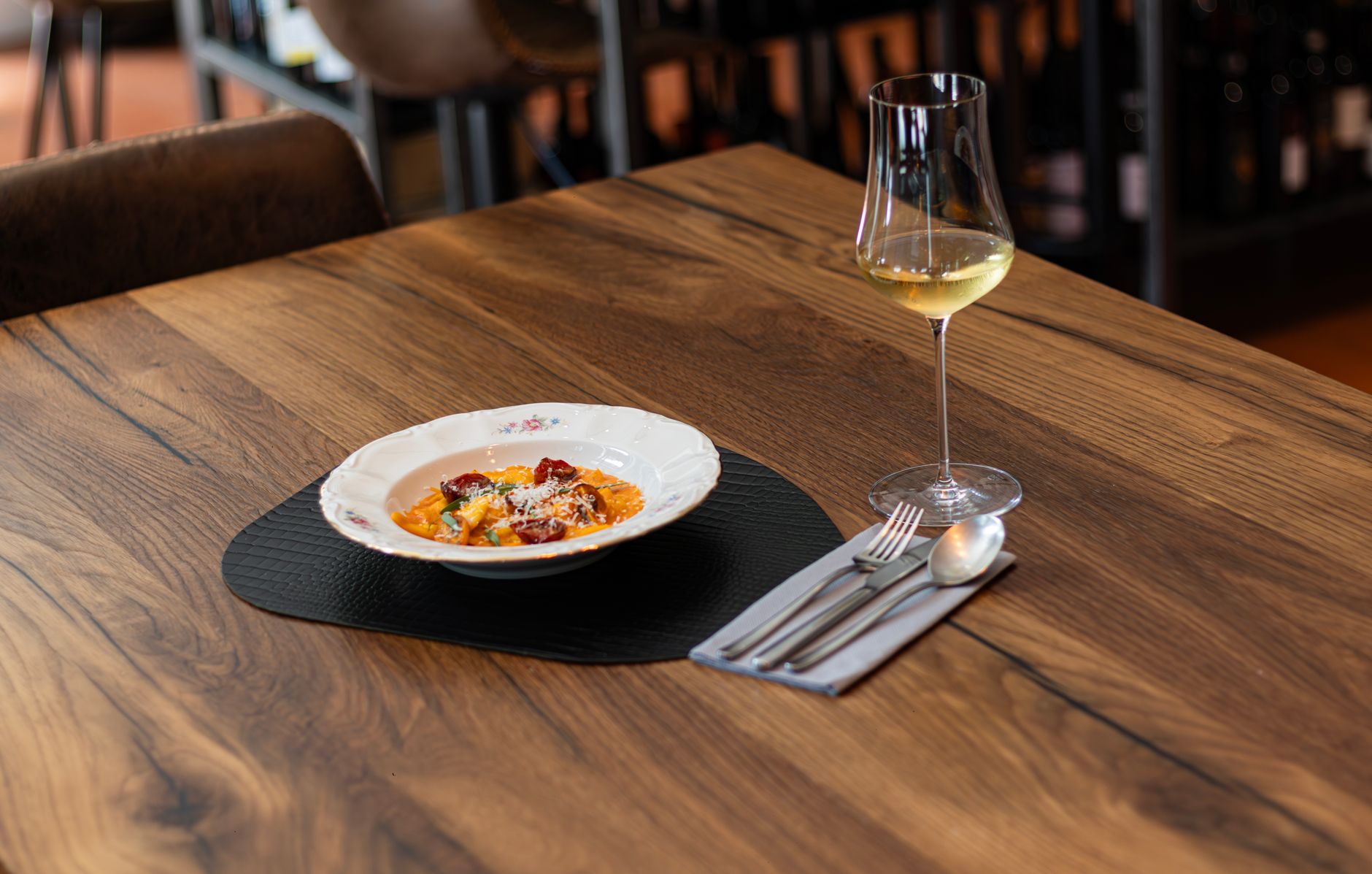
For years, we thought that dining well out meant spotless tablecloths, oversized plates with minuscule portions, and waitstaff capable of describing a tomato for five minutes.
Then something changed.
Today, some of the most sought-after spots look more like a home kitchen, a neighborhood bar, or a slightly eccentric trattoria than the old-school “fine dining” restaurant. Short menus. Shared plates. Close-set tables. Open kitchens. Mismatched chairs. Chalkboards, paper, stainless steel, wine poured without too much ceremony.
It is not just an aesthetic trend. What we look for when going out to dinner has changed.
Luxury today tries not to look like luxury
For a generation raised photographing what it eats, the most compelling venue is not necessarily the one flaunting its price tag. It is the one that feels spontaneous while being meticulously thought out.
A plate of pasta can become more desirable than a dish with fifteen ingredients if it tells a more relatable story. A venue can afford to be loud, small, and even slightly uncomfortable if it manages to create the feeling that everyone wants to be there.
It is the new dining aesthetic: looking simple has become extraordinarily complicated.
Behind the spontaneity lies a meticulous design
The handwritten wine list, the deliberately imperfect logo, the open kitchen, the dim lighting, the dish served in a seemingly ordinary bowl: none of this is necessarily accidental.
The contemporary restaurant is also a cultural product. It must work in real life, but it must also have a recognizable image. It must be photogenic without looking as though it were designed solely to be photographed. It must have personality, without giving the impression of trying too hard.
It is a delicate balance. When it works, the customer does not think about branding. They think they have found an authentic place.
A short menu is also a statement
One of the clearest signs of this shift is the streamlined offering. Fewer dishes, stronger identity. Not a hundred choices, but a selection that immediately tells you what kind of place you are dealing with.
For the guest, it means placing greater trust. For the restaurant, it means being more recognizable. And in a city packed with venues, being recognizable often matters almost as much as being good.
The same goes for service. Formality hasn't disappeared, but it is no longer the only viable code for conveying quality. A server can be thoroughly knowledgeable without playing a part. A kitchen can be ambitious without staging a solemn little ritual around every dish.
The real product is the feeling of having discovered something
The contemporary restaurant doesn't just sell what's on your plate. It sells an atmosphere, a group of people, a neighborhood, a way of being together. Above all, it sells a very powerful feeling: that of having arrived at the right place before everyone else found out about it.
It is a promise that is nearly impossible to keep, because as soon as a spot becomes truly desirable, it inevitably ends up in Stories, Reels, guides, and WhatsApp groups.
And yet, we keep searching for that feeling.
Perhaps this is the new luxury in dining: not being treated as guests in a flawless venue, but feeling, for a couple of hours, part of a place with a personality strong enough to seem imperfect.
Authenticity has become part of the product
The National Restaurant Association's 2026 What’s Hot Culinary Forecast clearly captures this shift in dining tone: comfort, reinterpreted nostalgia, value, and quality matter more than formality for its own sake. That doesn't mean service or technique are less important. It means customers are increasingly unwilling to pay purely for an aesthetic code.
A contemporary restaurant can have simple tableware, tightly packed tables, and a concise menu, but it must establish a clear identity. Informality works when it feels consistent with the cuisine, price point, and pace of service; if it's just carelessness, the public notices.
The real evolution, then, is this: perfection isn't disappearing, it's shifting. From pressed tablecloths to the invisible precision of the experience, from table spacing to the choice of ingredients, from ceremonial ritual to the ability to make guests feel they are in the right place.


