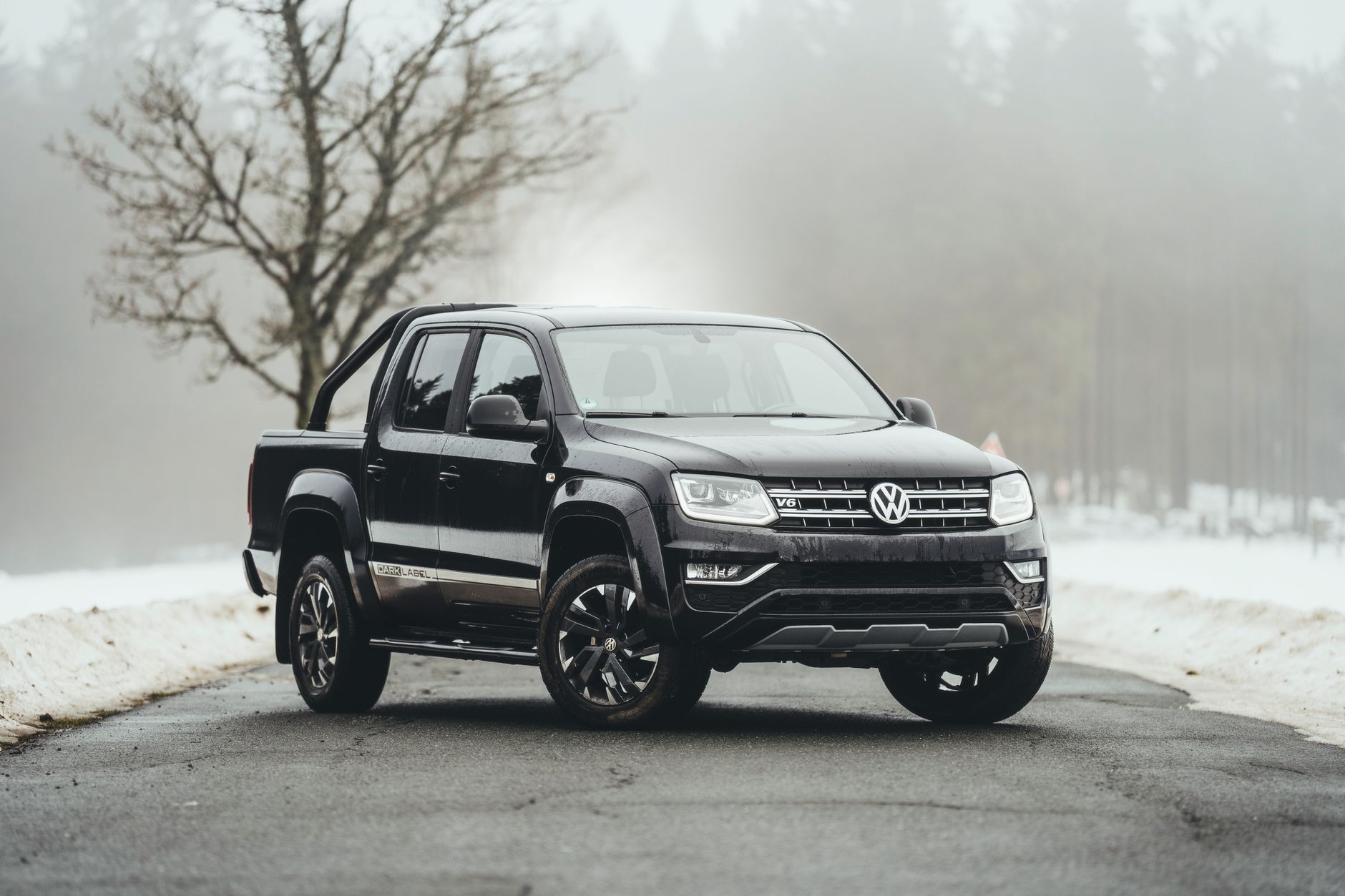
Volkswagen is considering strengthening its North American lineup with more rugged vehicles, including SUVs and pickups. This is not yet a model announcement, nor an industrial plan with finalized specifications and dates, but rather the strategic direction outlined by the group under its Future Plan 2030: the United States requires a product range more closely aligned with segments capable of sustaining volume and profitability.
The move is significant because Volkswagen’s presence in the US market consists primarily of unibody SUVs and sedans, while full-size pickups and body-on-frame off-roaders remain dominated by domestic automakers and select Asian brands. Entering that space would mean competing for a highly demanding customer base, but also attempting to tap into segments where average transaction prices, options, and high-margin trims carry far greater weight than in compact cars.
Thomas Schäfer, CEO of Volkswagen Passenger Cars, explained on September 3 that the brand will pursue a dedicated strategy for North America, modeled after regional approaches already adopted in China and Europe. Among the opportunities to explore, he cited the body-on-frame segment—vehicles built on a chassis separate from the body—and explicitly included rugged SUVs and pickups as potential components of the future portfolio.
A product choice within a cost-cutting plan
The American outlook is therefore not an isolated initiative. Volkswagen’s supervisory board approved Future Plan 2030 on September 3, initiating a reorganization phase that reportedly includes halving the model portfolio and cutting 50,000 jobs. The stated goal is to raise the operating margin to 9% by 2030.
In a plan aimed at streamlining the company's structure, the potential introduction of US-dedicated products may seem counterintuitive: developing a new family of vehicles requires investment, suppliers, manufacturing capacity, and an aligned dealer network. Yet an offering built around local preferences can be seen as a way to avoid importing solutions to North America that were designed primarily for other markets and adapted only as an afterthought.
For Volkswagen, this is not merely a question of entering a currently untapped segment. SUVs and pickups of varying sizes and purposes can generate ancillary revenue through configurations, trims, towing packages, and commercial applications, while also shaping brand perception in a region of the United States where practicality, payload capacity, and off-road capability carry more weight than the German automaker's traditional European positioning.
The leadership change in the region fits into the same strategy. Effective October 1, Marco Schubert will succeed Kjell Gruner as CEO of Volkswagen Group of America. Schäfer identified North America as a crucial market for achieving the group's financial targets; the incoming leadership will therefore be tasked with translating strategic direction into commercial and product decisions, in a market where Volkswagen cannot simply replicate its European playbook.
Pickups, body-on-frame SUVs, and many unknowns
The available information, however, does not yet allow for a clear picture of what will actually arrive in dealerships. An earlier Reuters report, published in August, pointed to a mid-size pickup slated for production in the United States. Should the project materialize, it could be developed specifically for North America rather than matching the Amarok sold by Volkswagen in Europe, Australia, Africa, and Latin America.
The prospect of a body-on-frame Volkswagen SUV is even less defined. While Schäfer's comments open up that possibility, they come with no name, platform, assembly plant, or details on powertrains and fuel types. It is also unclear whether the company envisions vehicles intended primarily for recreational use, work, towing, or a combination of these roles. These are critical distinctions: in the rugged vehicle market, chassis type is only part of the equation, and product identity matters just as much as architecture.
An internal document cited by WardsAuto reinforces the idea of a repositioning: Volkswagen has reportedly indicated a clear focus on “rugged vehicles,” placing greater priority on models and variants designed specifically for North America. Here too, it is necessary to distinguish a strategic signal from industrial confirmation. The publication reports the contents of an internal resolution submitted to the board of Volkswagen AG; at present, there are no official announcements regarding a price list, a launch timeline, or specific investments.
Caution is particularly important because a pickup and a body-on-frame SUV are not merely new body styles to add to an existing lineup. Volkswagen would need to decide whether to proceed with independent development, alliances, component sharing within the group, or other solutions. It would also need to define where in the lineup to position them and how to differentiate them from offerings already within the Volkswagen perimeter. Until these issues are resolved, speaking of a new model family remains premature.
The separate role of Scout Motors
Any discussion regarding North America inevitably brings in Scout Motors, the group brand based in South Carolina that is preparing the Traveler SUV and the Tera pickup. Scout also recently showcased the Mountainside and “Trail-Ready” Traveler concepts, further interpretations geared toward more adventurous use. First deliveries of the Traveler and Tera are expected in 2028.
Scout demonstrates that Volkswagen views the off-road vehicle and pickup segment as compelling ground, but it does not automatically resolve the question of a product bearing the Volkswagen badge. They are distinct brands, with potentially different identities, dealer networks, and market positioning. Schäfer’s reference to SUVs and pickups within the Volkswagen Passenger Cars strategy therefore leaves open the possibility of initiatives beyond Scout, without providing definitive proof of them.
For the group, keeping the two plans distinct could be a useful move: Scout aims to build its own brand identity around rugged electric vehicles, while Volkswagen can pursue a broader offering or one closer to its existing dealership network. At the same time, any overlap in price, size or customer base would need to be handled carefully. This is one reason why industrial details, which are currently lacking, will be more important than the statement of intent alone.
A North American portfolio facing possible transformation
Cupra also features in the emerging rumors. WardsAuto reports that the group is once again evaluating a US launch for the Spanish brand, after the entry plan slated for 2030 was postponed indefinitely last year. The interest reportedly fits into the strategy of giving Cupra more room, while Seat is expected to exit the stage by 2029.
It is an element that points to a broader overhaul of how Volkswagen aims to tackle the American market: not just a single new body style, but a combination of products and brands tailored to specific segments. However, there is a considerable gap between weighing an opportunity and making a commercial commitment. Cupra, like any prospective Volkswagen SUVs and pickups, does not yet have operational confirmation for the United States.
The next developments to watch will mainly concern four areas: the potential approval of a pickup project, the choice of the technical platform for a possible body-on-frame SUV, US production allocation, and the relationship between Volkswagen and Scout. For now, the group's message is clearer on the industrial side than on the product side: to improve margins, North America will not be treated as a mere extension of the global lineup.


