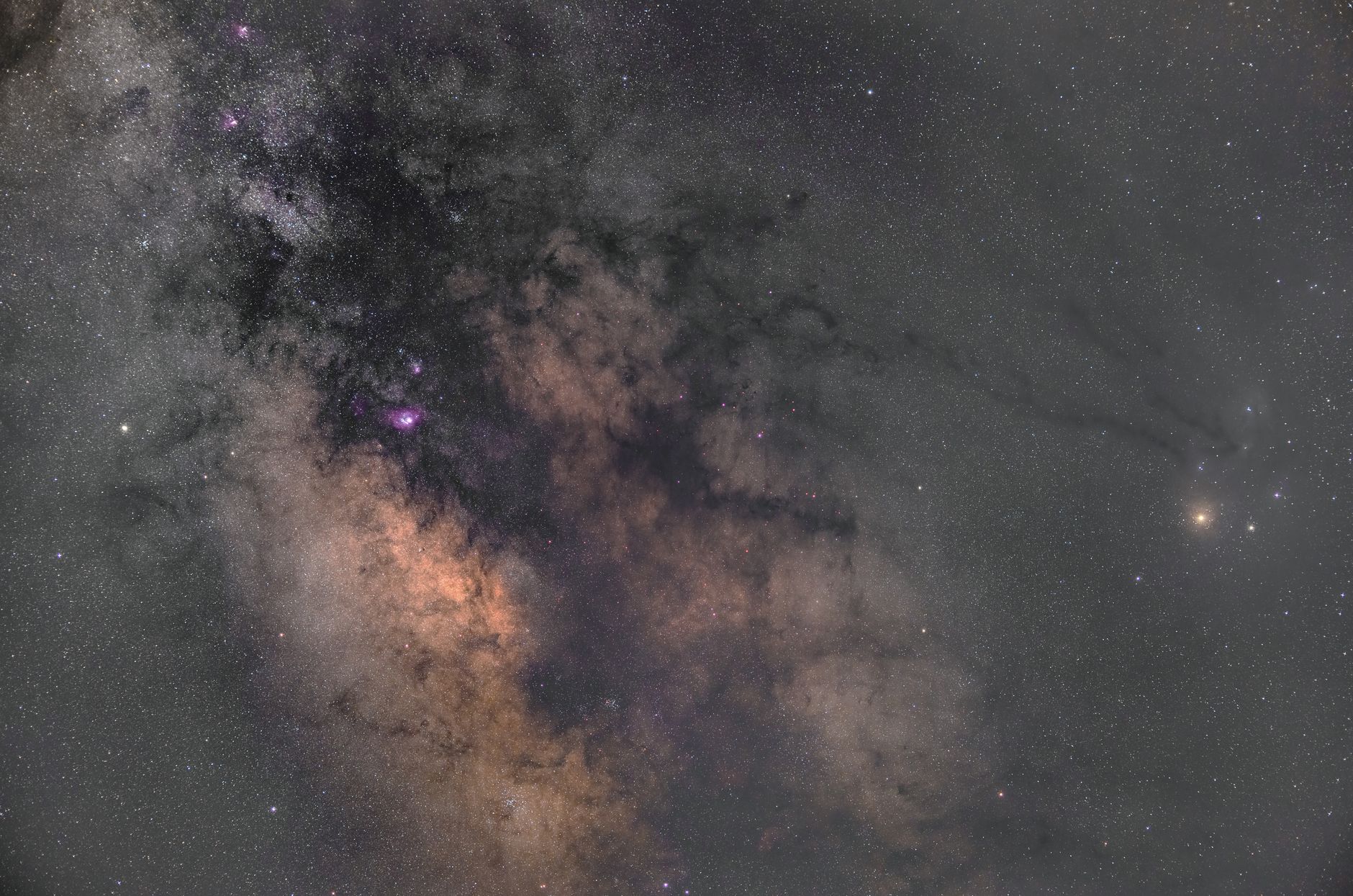
At the center of the new image released by NASA on August 11, 2026, is not Sagittarius A* itself—the Milky Way's supermassive black hole—but rather IRS 3: a star in an advanced stage of its evolution, immersed in the crowded environment surrounding the galactic center. The observation was made by the James Webb Space Telescope and captures a field in which the brightest stars emerge amid diffuse structures of gas and dust.
However, the most significant takeaway goes beyond the visual impact of the image. Webb's mid-infrared measurements have made it possible to identify the signature of oxygen-rich silicate dust and the presence of water around IRS 3. These clues help shed light on the chemistry of matter ejected by aging stars, even in a very particular region of the Galaxy: the one shaped by its proximity to its center.
The NASA release thus offers a fresh look at an object already known to astronomers, achieved with a sensitivity and an ability to resolve infrared components that make Webb particularly well-suited for studying dust-shrouded environments. Indeed, in visible light, the view toward the center of the Milky Way is heavily obscured by interstellar material. Infrared light allows us to peer past part of that veil and gather insights not only into the stars themselves, but also into the substances enveloping them.
An evolved star in the galactic center field
IRS 3 is located in the stellar field close to Sagittarius A*, the source associated with our galaxy's supermassive black hole. This location is significant because the galactic core is far from a quiet region of space: the density of stars, gas, and dust makes interpreting observations more complex, while local conditions can affect the survival and distribution of materials.
NASA describes IRS 3 as a star near the end of its life cycle. In these phases, stars can shed into surrounding space matter produced or reprocessed throughout their existence. The dust observed with Webb is therefore part of a broader story: elements and compounds leaving the stars enter the interstellar medium, where they can take part in the physical and chemical processes that govern the evolution of galaxies.
In the case of IRS 3, the identification of oxygen-rich silicates provides direct characterization of the solid or dusty component associated with the object. Silicates are silicon- and oxygen-based materials that are common in cosmic dust. Detecting their signature means more than just assigning a color to nebulosity in an image: each substance interacts with radiation in a characteristic way, leaving imprints in the infrared data that help determine what lies along the line of sight or around a source.
Why the mid-infrared makes the difference
Webb was designed to observe the universe in the infrared, a portion of the electromagnetic spectrum essential for tackling two recurring obstacles in astronomy: cold and dust. Objects and materials that do not stand out in visible light can emit or alter infrared radiation in detectable ways; at the same time, infrared wavelengths are better able to penetrate obscured regions than optical light.
The new observation specifically relies on mid-infrared data. In this band, dust composition becomes readable through specific spectral features. For IRS 3, Webb clearly detected oxygenated silicates and water. The result demonstrates the value of combining a high-definition image with chemical information: the former helps distinguish the context, while the latter transforms the scene into a physical measurement.
This is a crucial distinction in the communication of astronomical imagery as well. The color tones processed to render signals visible do not constitute a photograph in the everyday sense of the term, but rather a representation of data collected across different wavelengths. Their purpose is to make structures and emission differences recognizable that the human eye could not see directly. Behind the concentration of bright spots at the center of the composition, there is therefore an analysis focused on the nature of the materials, not just their position.
Water and dust, without turning a chemical indication into something else
The presence of water reported by NASA needs to be put into proper perspective. It does not describe seas, habitable planets, or conditions favorable to life in the IRS 3 system. In infrared astronomy, detecting water means identifying a chemical component through its signature in the data. Even so, it is valuable information, because water is a key molecule in the chemistry of the interstellar medium and because observing it, alongside silicates, helps define the star’s environment.
Similarly, speaking of dust should not necessarily evoke something akin to terrestrial dust. In astronomy, the term encompasses tiny solid particles in space capable of absorbing, scattering, and re-emitting radiation. For this very reason, dust can both obstruct the view toward the galactic center and serve as a scientific target: studying its composition and distribution helps reconstruct the cycles of matter between stars and interstellar space.
The value of the Webb image therefore lies in its ability to bring these scales together. On the one hand, there is a single evolved star, IRS 3; on the other, the crowded environment near Sagittarius A*, the most well-known landmark of the Milky Way’s core. In between are the chemical compounds that bridge the stellar object and its surroundings.
What remains to be understood
NASA's release presents an image and the key elements detected, not an exhaustive picture of the origin, quantity, or three-dimensional distribution of all observed matter. From this data, it is not possible to deduce, for instance, the detailed history of the mass ejected by IRS 3, nor to automatically extrapolate its properties to all stars in the galactic center. These are standard limitations for a single visual release, especially in a region where multiple sources can overlap along the same line of sight.
However, the result reinforces why the James Webb Space Telescope is also deployed to study the nearby universe, in addition to the most distant galaxies. The center of the Milky Way remains an accessible yet challenging laboratory: it is close enough to be studied in great detail, and obscured enough to require instruments capable of operating in the infrared. Observations like that of IRS 3 make the map of substances present in that area more concrete and pave the way for targeted analyses of other objects and components of the galactic core.
For the public, the image ultimately offers a less spectacular but more insightful look at Sagittarius A*. The black hole remains the primary focal point of the region, but the matter surrounding it and the stars going through their final stages tell an equally essential part of the galactic center's story. Webb is not merely gazing toward the heart of the Milky Way: amid the crowding, it is distinguishing the materials that heart is made of.


