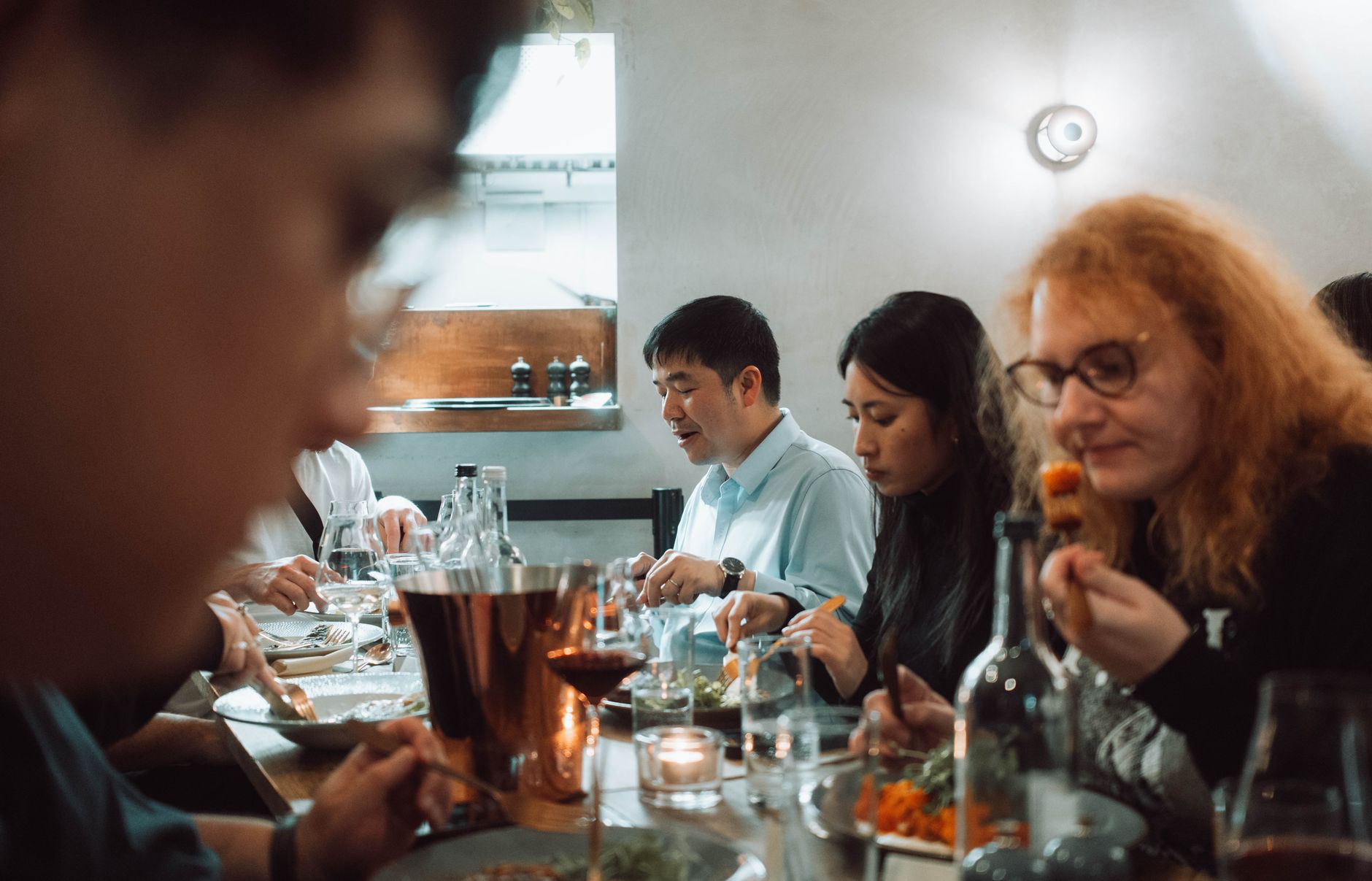
Eating is a biological necessity. Eating together is a social construct.
For centuries, we have used the table to do things that have almost nothing to do with hunger: meeting people, celebrating, negotiating, arguing, reconciling, courting, recounting a day, building family and friendships.
It is striking that such an ancient gesture continues to work in a world where almost every other experience has become faster and more individualized.
The meal creates shared time
The most important thing about a shared dinner is not necessarily what is eaten. It is that, for a certain period, people agree to share the same rhythm.
You wait for others to arrive, you order, you share, you stay seated. Even when everyone checks their phone from time to time, the table continues to create a common structure.
We cannot completely speed up a meal without destroying part of its meaning.
Food solves the “what are we doing?” dilemma
Many adult relationships suffer from a trivial difficulty: finding a simple reason to meet up. A meal offers an automatic answer.
“Let’s get dinner” does not require a specific activity, a skill, or an elaborate plan. It provides enough structure to avoid awkward emptiness and enough freedom to leave room for conversation.
It is a perfect social technology precisely because we barely perceive it as one.
Sharing something changes the relationship
Placing dishes in the center, tasting what someone else ordered, choosing a bottle together: these are small gestures that turn a collection of individuals into a temporary group.
Even the way a restaurant designs its menu can encourage or hinder this dynamic. The resurgence of sharing plates is not just a culinary trend. It responds to the desire to make the meal less sequential and more collective.
Food delivery has separated good food from the social experience
Today, we can eat exceptionally well without leaving home and without seeing anyone. It is an enormous convenience, but it makes it even clearer that a restaurant’s value does not coincide with the contents of the plate.
We also pay to be in a space where other people are doing the same thing. Noise, service, lighting, waiting, and the presence of others are all part of the experience.
The table remains a place of imperfect equality
Naturally, not all meals are convivial, and not every gathering around the table is a happy one. Food can also reflect economic, cultural, and family differences.
Yet sitting at the same table retains a unique symbolic power. For a moment, people share at least one basic need.
Perhaps the future of food will be even more social
The more parts of our lives become digital and personalized, the more valuable the spaces that force us to synchronize with others become.
Restaurants, home kitchens, and festive tables will likely continue to thrive precisely because of this.
We can order everything on our own, watch different content, work from different places, and build entirely personalized days. But when we eat together, we still have to do something ancient: wait for one another.
And it is possible that part of the value of food lies precisely there.
Research confirms that shared meals matter
In 2026, a peer-reviewed study published in Scientific Reports by researchers affiliated with the Wellbeing Research Centre in Oxford analyzed international and U.S. data on the relationship between shared meals and well-being. How frequently people eat with others was found to be positively associated with life satisfaction across nearly all observed regions.
The authors also show that, in the American data, those who share at least one meal with others tend to report higher happiness and lower stress, sadness, and pain on that same day. The study does not turn dinner into a cure, nor does it prove that every effect is causal, but it makes measurable something cultures have known for centuries: eating together is a powerful form of social connection.
Perhaps the most compelling finding is the opposing trend: in the United States, meals eaten alone have increased over time, especially among younger people. In a world where countless experiences are becoming individual and on-demand, the dining table retains a surprisingly contemporary function.


