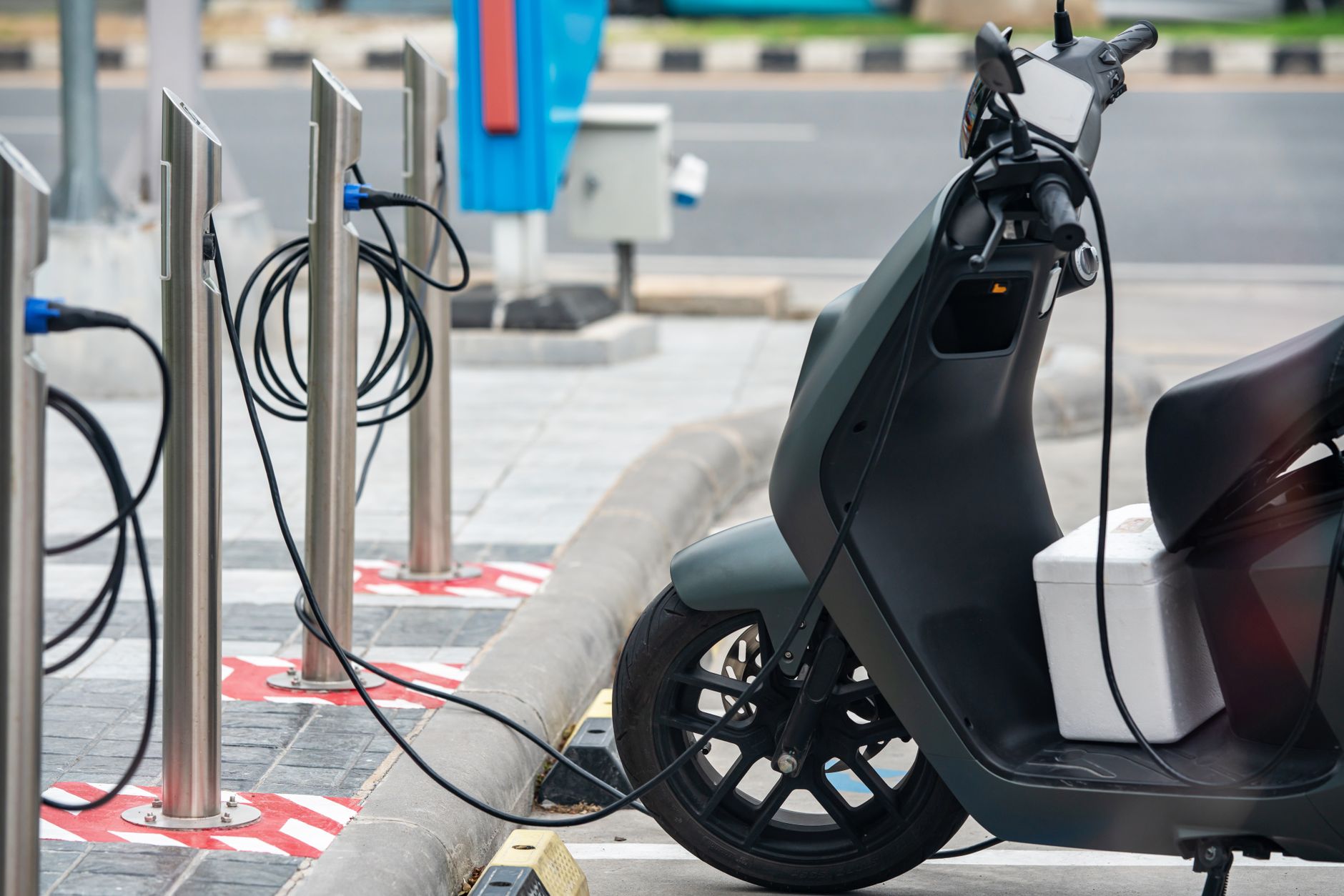
Battery swapping has not conquered the global automotive market, but in India it may have found the market it was truly made for. Magna International has decided to invest an additional $35 million in Yuma Energy, a Bengaluru-based company operating a rapid battery-swapping network for scooters, motorcycles, and three-wheeled electric vehicles. The investment increases the stake held by the Canadian group, which already owned 51% of the joint venture launched in 2023 alongside Yulu.
Yuma claims to have completed more than 60 million swaps and to have around 100,000 batteries in circulation. The network includes over 400 stations and more than 2,500 charging units across 18 Indian cities. The capital will primarily be used to expand infrastructure and double the number of batteries over the next 12 to 18 months.
Two minutes change the economics for a rider
For a private user, waiting 20 or 30 minutes for a charge may be acceptable. For a rider who only earns while the vehicle is operational, that time represents lost income. Yuma claims that a battery can be swapped in under two minutes.
This is where the model finds its edge. India has a massive gig economy and a base of two- and three-wheelers far larger than that of passenger cars. Standardizing small, manageable batteries is significantly easier than swapping packs weighing hundreds of kilograms beneath a car.
Battery swapping shifts the problem from power to inventory
A fast-charging station has to deliver a large amount of power in a short period. A swap network can recharge batteries slowly behind the scenes and hand over one that is already ready. It reduces peak power demand, but it must own enough batteries to keep users from running into empty shelves.
This makes the model capital-intensive. Yuma must fund batteries and stations before demand utilizes them fully. Management acknowledges that unit economics improve with scale.
Not yet profitable
The company is not yet profitable overall, although some mature stations are reportedly EBITDA-positive. In the fiscal year ended March 2026, it posted revenue of around one billion rupees, equivalent to just over $10 million, and is targeting EBITDA break-even in the coming quarters.
The gap between revenue and invested capital shows how infrastructural the project is. Its value cannot be judged like that of a software app: batteries and stations require continuous physical investment.
Yulu remains the dominant customer
The vast majority of historical swaps come from Yulu, but Yuma wants to reduce this dependence. In the last quarter, about 15-20% of swaps reportedly came from other customers, and the goal is to bring that share to 25% over the next two years.
The company has integrated its batteries with more than ten vehicle platforms and serves multiple fleets. Interoperability is crucial because a swapping network tied to a single brand risks failing to reach the necessary density.
Standardization is the real obstacle
In the global automotive market, different manufacturers use different packs, voltages, thermal systems, and architectures. This makes a universal battery difficult. In urban two-wheelers, the issue is more manageable, but it does not disappear.
Yuma designs and manufactures its own packs and charging units. Controlling both hardware and network allows it to guarantee compatibility, but it requires convincing manufacturers and fleets to adopt the system.
Magna brings industrial expertise
Magna is one of the world's largest automotive suppliers. Its involvement is therefore not merely financial: expertise in production, quality, and supply chain can help Yuma scale a hardware infrastructure.
For Magna, the investment is also a window into an electrification model different from the one dominant in Europe and North America. In two-wheeler markets, the future might not be a scaled-down copy of the electric car.
Expansion remains focused on India
In the short term, Yuma aims to expand into Chennai and Pune and reinforce its presence in existing cities. In the long term, it is watching Southeast Asia and Africa, regions with massive two-wheeler markets. However, it has not yet announced any concrete international expansion.
It is a useful discipline: the model must first prove it works economically in a market where conditions are particularly favorable.
Swapping could be a local technology, not a universal one
The history of energy is full of solutions that work very well in one context and poorly in another. Battery swapping could be one of them. It does not need to replace charging in every vehicle to become important.
If millions of riders can reduce downtime and switch to electric thanks to a dense network of swappable batteries, the model will have already solved a massive problem. Magna’s 35 million is a bet precisely on this specialization: not finding a universal system, but the right one for high-utilization urban mobility.


