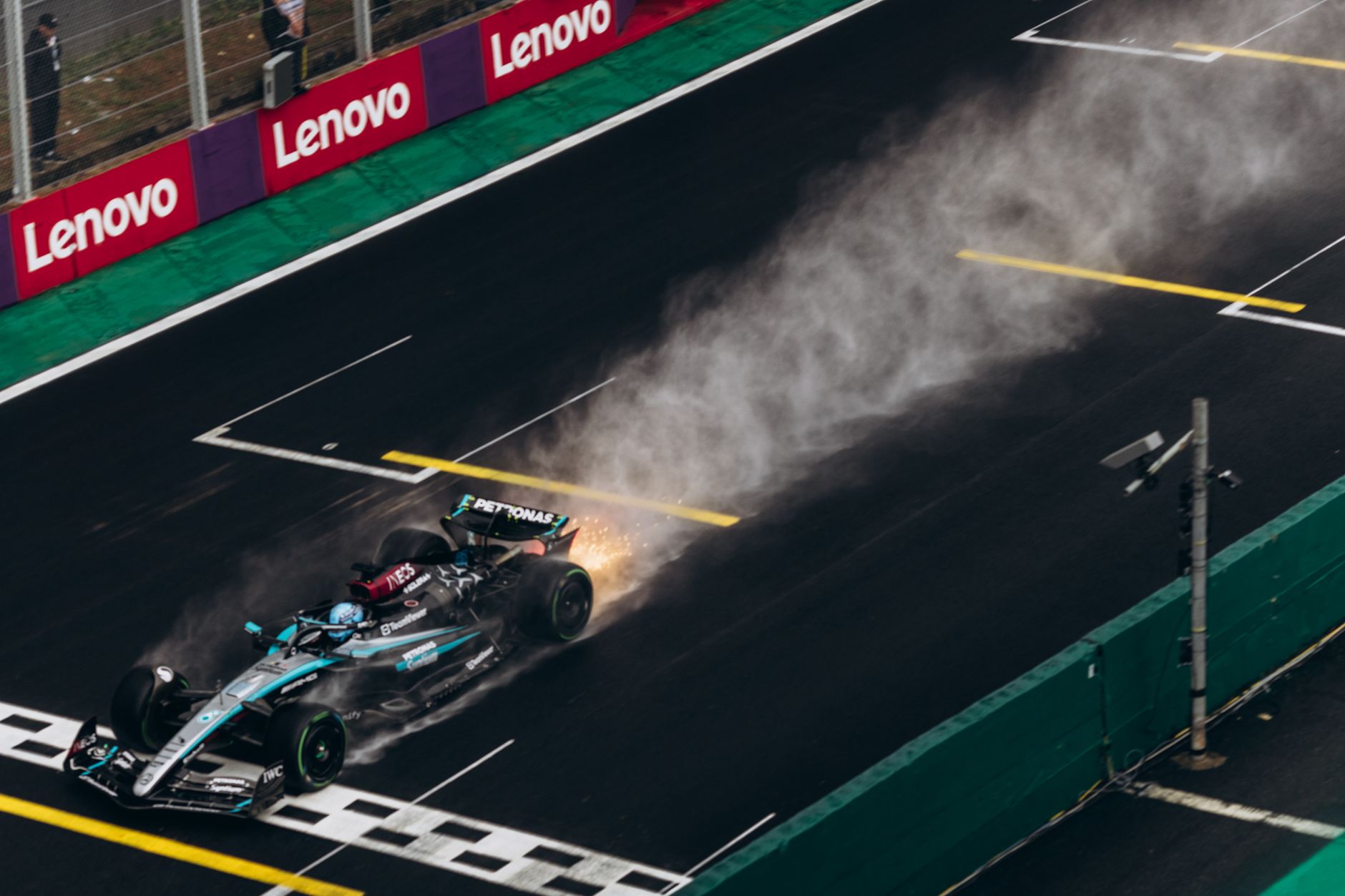
Formula 1 approaches the final stretch of 2026 with a pecking order that few would have predicted after the years of Red Bull dominance and the subsequent emergence of McLaren: Mercedes is once again leading the field. The German team has built a substantial lead in both the drivers' championship and the constructors' standings, shifting its focus from playing catch-up to identifying the possible dates to mathematically seal the titles.
After 17 Grands Prix, Andrea Kimi Antonelli leads the drivers' standings ahead of teammate George Russell by 102 points. In the constructors' championship, Mercedes sits at the top with 578 points, with Ferrari second on 444: 134 points therefore separate Brackley from Maranello. McLaren, on 339, and Red Bull, on 332, remain mathematically in contention, but the deficit is now large enough that the head-to-head battle between Mercedes and Ferrari has become the true focus of the run-in.
The most telling figure is race victories: eleven Mercedes wins in the opening 17 Grands Prix. A significant portion came during the early stages of the season, when the new regulatory cycle decisively rewarded the Stuttgart manufacturer's concept. In the meantime, rivals have trimmed the performance gap, but not enough to undo the damage accumulated in the standings. In Formula 1, making up tenths of a second per lap and making up points in a championship are two very different tasks: Mercedes has already accomplished the latter.
Why Austin cannot award the constructors' title
The six remaining rounds offer 258 points in the constructors' standings, accounting for the scheduled races and Sprints. Following the United States Grand Prix, 215 will remain available. This detail ensures that the teams' title cannot be decided in Austin: Ferrari will remain within that threshold relative to Mercedes regardless of the result in Texas.
The outlook is different for McLaren and Red Bull. To stay in contention after Austin, they will need to keep the gap within 214 points; a 215-point deficit would already be fatal. At that point, the tiebreaker based on win count comes into play—a metric in which Mercedes holds such a commanding advantage that it leaves no room for either rival. McLaren would therefore need to outscore Mercedes by at least 25 points over the weekend, and Red Bull by at least 32: scenarios possible only on paper, rather than a realistic forecast given the trends of the season.
Ferrari, on the other hand, cannot be eliminated in the United States. This keeps an important chapter open for the championship and for the team's messaging: the Maranello squad no longer controls its own destiny, but it can still prevent Mercedes from celebrating too soon. In a season where every result also impacts the perceived value of the technical project and internal confidence, prolonging the battle carries a significance that goes beyond mere arithmetic.
Mexico could become the first decisive round
The first realistic window for the ninth Mercedes constructors' title is the Gran Premio del Messico. However, it requires a favorable combination of results starting as early as Austin. The extreme scenario is clear: Mercedes must finish the United States weekend with a one-two finish and Ferrari scoring no points. Under this scenario, the lead would increase from 134 to 177 points.
Leaving Mexico, there would be 172 points still available across the final four races. With a 177-point cushion heading into the weekend, Mercedes would only need to avoid conceding more than four points to Ferrari across the Mexican weekend alone to place the title out of reach. If the Scuderia were to recover five or more points, the decider would be postponed at least until the following round.
It is a tall order, demanding a near-flawless execution from Mercedes across two consecutive weekends while simultaneously requiring Ferrari to come away empty-handed in Austin. It should not, however, be mistaken for a prediction: it is the fastest route, not the most probable one. The strength of the current advantage lies precisely here. Even without sealing the title in Mexico, Mercedes will have several opportunities to cross the finish line; Ferrari, meanwhile, would need a overwhelmingly favorable run of results and external mistakes to truly overturn the deficit.
Furthermore, all calculations assume that Qatar and Abu Dhabi will take place as planned. Both rounds remain tied to developments in the conflict in the Middle East, introducing an element of off-track uncertainty. Any potential revision to the calendar would reduce the remaining points and immediately alter the thresholds for mathematically clinching the titles. For this reason, projections in the paddock are valid only on the basis of the currently scheduled calendar.
Antonelli can close out the individual title race earlier
The drivers' picture presents an interesting contrast with the constructors' standings. Antonelli holds a 102-point lead over Russell and could claim his first world title as early as the next round in Austin. However, the most likely scenario, according to projections based on available points, is a resolution in Mexico.
For Mercedes, it would be an outcome carrying particular weight. Following the 2020 drivers' title, the ground-effect era shifted the center of gravity in Formula 1 toward Red Bull and then McLaren; returning to the top with Antonelli, in a season ushered in by new regulations, would reinforce the view of a team capable of regaining competitiveness whenever the technical framework is rewritten. Russell, although far from the top, rounds out a season that turned the car's performance advantage into a substantial collective asset.
However, the Drivers' and Constructors' World Championships do not share the same dynamics. The former captures an individual's performance and their margin over their teammate; the latter rewards the consistency of two cars, reliability, strategy, and the ability to limit damage on difficult days. It is precisely on this second front that Mercedes built its position: not just the highs of eleven victories, but the ability to score points with both drivers.
A title that also carries weight in the team's recent history
Should Mercedes clinch the constructors' championship, it would reach nine titles, matching Williams and trailing only Ferrari, leading with 16, and McLaren with 10. It would mark its first triumph in the teams' standings since 2021 and its first double championship since 2020, the final season shaped by pandemic restrictions.
For Ferrari, the finale is not without intrigue, even if the margin calls for caution. Finishing second and keeping pressure on Mercedes means preserving the sporting value of a season without decisive title-contending victories, as well as gathering insights on a car that has steadily closed the gap. McLaren and Red Bull, by contrast, risk falling out of mathematical contention in the constructors' race very soon: an outcome that would turn the remaining races primarily into a testing ground ahead of 2027.
The next answer will come in Austin. It will not yet be the day of the Mercedes constructors' title, but it could radically change the celebration timetable: a one-two finish for the Silver Arrows accompanied by a zero-point finish for Ferrari would set up a Mexican match point. Otherwise, Mercedes will have to wait, with a lead that remains wide but with mathematical certainty still to be won on track.