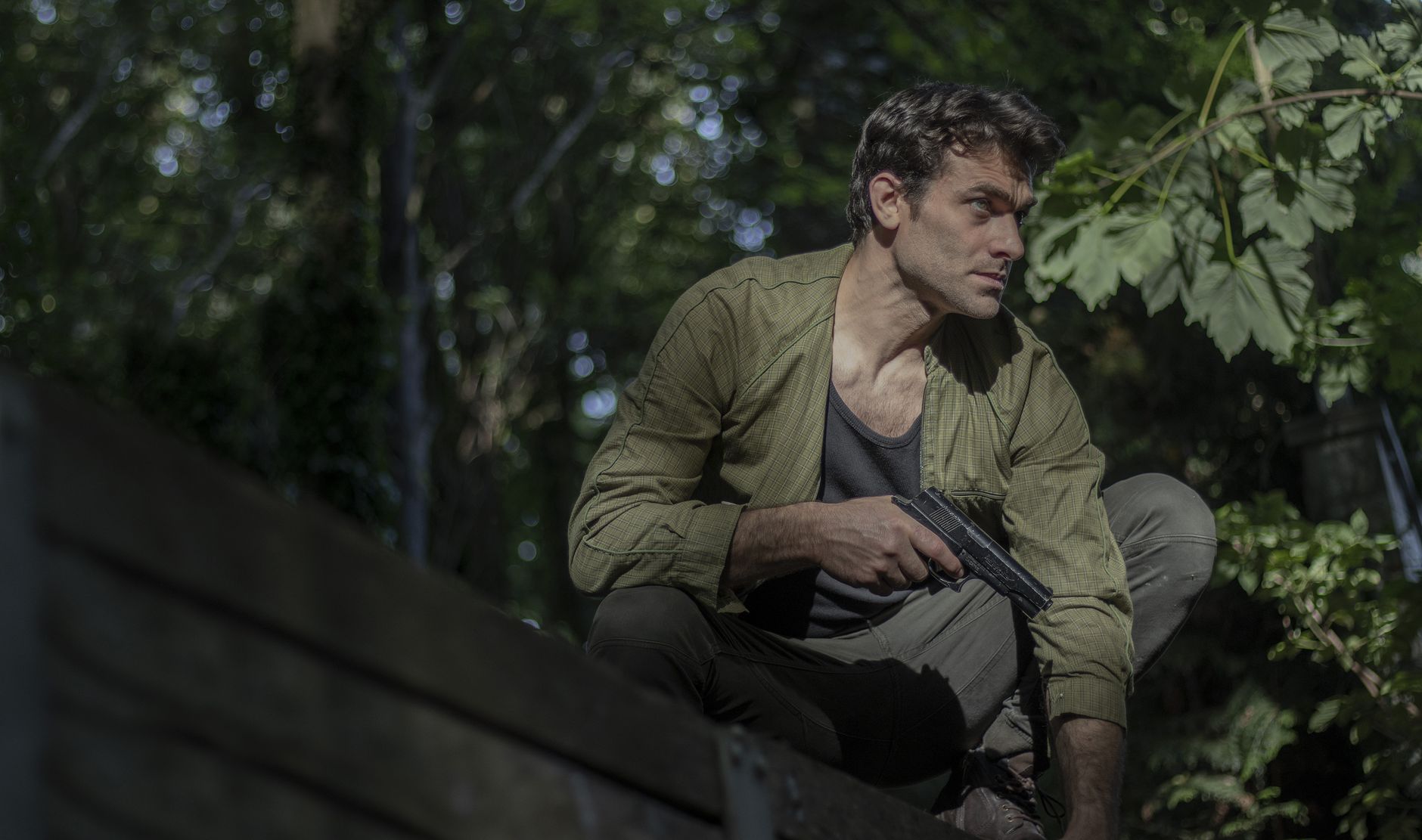
The Fix arrives with the recognizable hallmarks of an American geopolitical thriller: a group of former CIA operatives, a field blunder that left personal and professional fallout, an unofficial return to duty, and a mission in Iran built on false identities, hidden cash, and betrayals. Zachary Levi stars as protagonist Tucker, while Liam Neeson plays Larry, their former Agency handler. On paper, it is a combination tailored to an audience accustomed to chases, covert operations, and international tension.
Written and directed by Israeli filmmaker Guy Moshe, the film displays solid craft without managing to translate its sheer volume of narrative material into truly sustained tension, according to a review published by Variety. The result is described as an enjoyable yet uneven action thriller: the nearly two-and-a-half hours fly by thanks to the pacing and mission plot beats, while the character writing and an accumulation of reveals ultimately undermine its ambition to construct a more layered espionage story.
From Kabul to the new operation in Tehran
The story begins with the 2021 evacuation of Kabul. Tucker and his team receive orders to extract a local ally before he falls into Taliban hands. During the operation, Tucker makes urgent decisions that defy direct orders: a choice that saves lives, but leads to the entire group being dismissed from the CIA. It is a prologue that immediately sets the film's central theme in motion: the blurry line between operational discipline, moral responsibility, and loyalty to the institution.
Once back in the United States, the former operatives struggle to adapt to civilian life. Tucker, in particular, keeps his distance from his ex-wife and son, convinced he is no longer capable of returning to normalcy. The opportunity to bring the group back together arises when Larry, suffering from early-onset dementia, begins disclosing classified information. Among these secrets is the story of a fortune hidden in Tehran during the fall of the Shah in 1979.
The trail leads Tucker to Paris, where he meets a woman connected to Larry's past. She is ready to reveal where the money is located, but sets one condition: rescue her daughter Maryam, an activist forced into hiding from Iranian authorities. From here, the story shifts setting and nature. The search for the loot fades into the background, with the operation emerging as an attempt to rescue a dissident from a repressive regime, in a country where Tucker's team cannot operate openly.
A recognizable cast inside a crowded narrative machine
To enter Iran, Tucker and his companions adopt various covers. He poses as a New Zealander interested in carpet exports and is accompanied by Zara, a university student who speaks Farsi and is brought along without fully understanding the trip's true objectives. The character is played by Elnaaz Norouzi. Maryam is portrayed by Lara Wolf, while Navid Negahban plays a high-ranking official who proves crucial to the unfolding action. The group also includes Quincy Isaiah, brought in to step in after the loss of a team member.
Pairing Levi and Neeson brings two screen presences catering to different audiences and archetypes. Neeson remains tied, also due to his recent filmography, to the archetype of the seasoned operative dragged into extreme circumstances. Levi, on the other hand, brings a lead less entrenched in the mature action genre and more focused on the scars left by operational experience. However, the film does not appear to fully exploit this potential difference in tone: Variety's review notes adequate performances, but characters lacking the complexity needed to support the screenplay's numerous twists.
It is a significant limitation for a thriller built on double-crosses. When alliances, identities, and motivations constantly shift, every twist must carry clear consequences and be grounded in the characters' prior development. In The Fix, the review suggests that the sheer number of reveals undermines their impact: the story keeps introducing suspicions and betrayals, but the mechanism ultimately feels more artificial than surprising.
The weight of the political context arrives after filming
The Iranian setting gives the film an inevitable resonance in the present day. Yet The Fix was shot before the current conflict between the United States and Iran referenced by Variety. Paradoxically, this temporal distance makes the work less tied to current events than its release might suggest. It was not conceived as a direct commentary on the ongoing escalation, yet it reaches audiences at a time when relations between Washington and Tehran are once again at the center of international attention.
The film also draws on highly sensitive historical and political references: the 1979 revolution, the fall of the Shah's regime, the apparatus of the Islamic Republic, the crackdown on dissent, and the clandestine presence of former American operatives. These are elements that would require a particularly clear line. Instead, the review notes an ill-defined political message, caught between action heroism, a rescue mission, and money-driven intrigue. For a production of this kind, ambiguity is not necessarily a flaw: it can make the protagonists' intentions more opaque. It becomes a problem when it fails to foster a deeper reading of the context, instead letting contrasting tones coexist that struggle to find a common direction.
This is also why the film can be perceived as anachronistic without being entirely out of step with the times. Its portrayal of Iran adheres to the tropes of infiltration cinema, complete with cover identities, surveilled buildings, and Western operatives forced to improvise. Current events make a comparison with far more complex real-world dynamics inevitable, but The Fix seems to favor the tradition of the muscular thriller over articulated political analysis.
The action works, but doesn't always raise the stakes
According to Variety, Moshe handles the action sequences competently, yet fails to inject a level of peril or inventiveness capable of turning them into the film's standout moments. Here too, a gap emerges between the scale of the setup and the final effect. The operation in Tehran includes infiltrations, shootouts, a kidnapping, and the search for a site that has been converted into a military facility—ingredients ample enough for a crescendo. However, the tension tends to slacken just when the narrative should be tightening its grip.
For the audiovisual market, The Fix captures a formula still prevalent in action cinema: an instantly recognizable cast, a politically charged and dramatically dense setting, a recovery mission, and a plot built to multiply obstacles. It is a model that can ensure accessibility, especially when audiences are looking for a genre narrative that remains straightforward in its primary objective. However, it requires restraint: piling on conspiracies is not enough to enrich a story, just as setting the action against a delicate geopolitical backdrop does not automatically guarantee depth.
The assessment outlined by the review is therefore that of a polished, entertaining film, yet one less incisive than its premise, cast, and the scale of its international production would suggest. Tucker's mission juggles personal drama, a rescue, and economic interests without allowing any of the three strands to clearly take precedence. It is precisely this hesitation that leaves The Fix in a middle ground: effective enough for those seeking a classic action thriller, but not rigorous or tense enough to stand out among the most memorable spy titles.