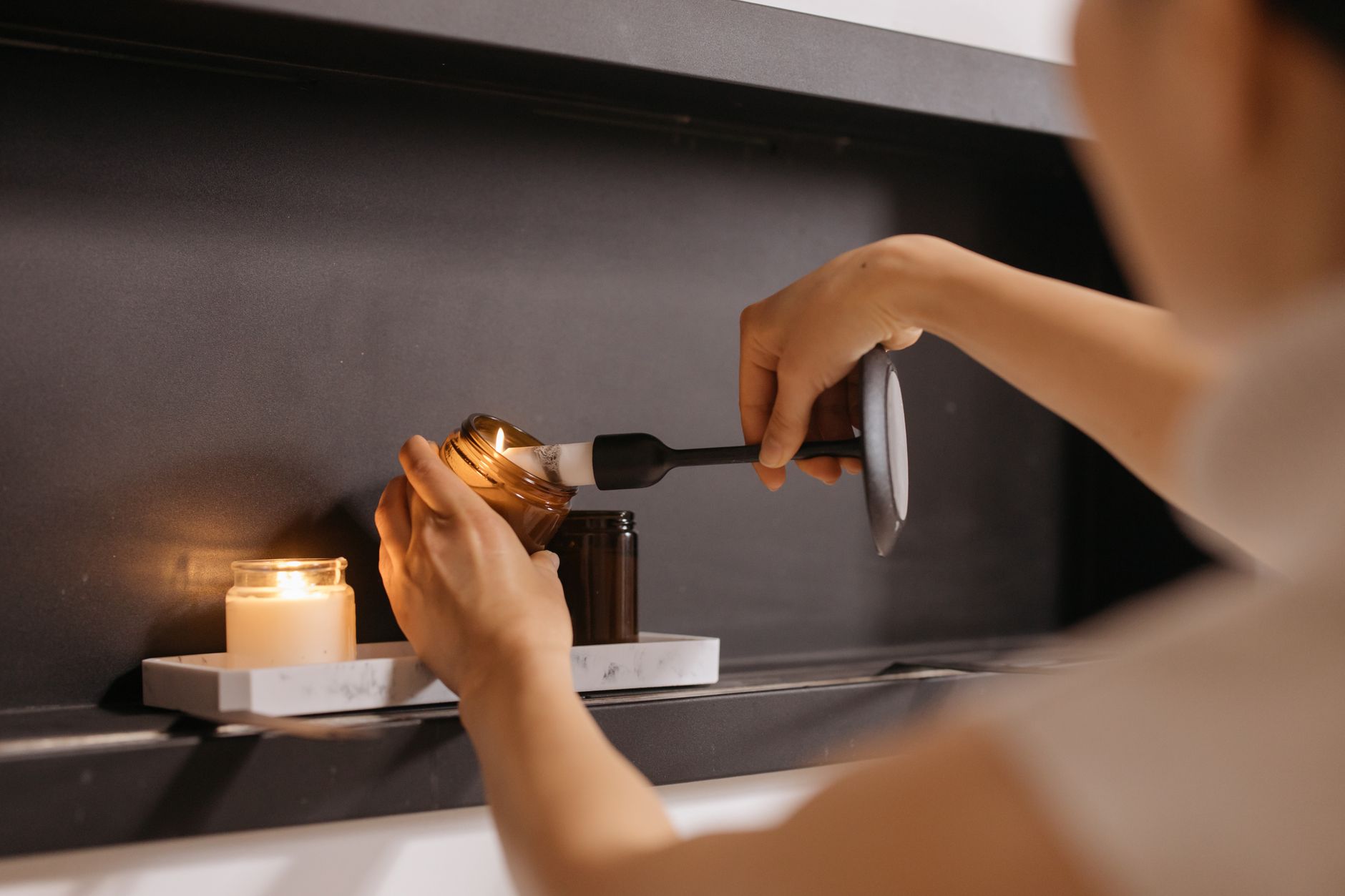
For Willy Chavarria, the runway show can go on even after the lights go down. The American designer has released the collaboration with Xinú first teased last June during the Spring 2027 presentation, titled Communión. At the heart of the project is FlordeMusgo, one of the Mexican fragrance house's six candles, now presented in a black ceramic vessel designed for this edition and branded with a Willy Chavarria medallion.
The departure from the candle's standard version, housed in a white container, is deliberately focused on the object. The olfactory composition remains that of FlordeMusgo: lime, cedarwood, tuberose, and moss. What changes instead is how the product occupies domestic space, shifting from a lighter, more organic design language to a dark, compact presence immediately recognizable within the designer's visual lexicon.
The candle retails for $120 on the Willy Chavarria website. It can be purchased individually or alongside the “Communión” match striker. It is a limited-edition release built around a design intervention rather than a new fragrance: a choice that brings together two established signatures without diluting Xinú's identity or turning the product into mere promotional merchandise.
From olfactory scenography to an object for the home
The collaboration had already become part of the narrative of Communión. During the June show, Chavarria scented the presentation with FlordeMusgo, introducing the candle as part of the ambient experience before unveiling its commercial debut. The decision to release the project a few months later allows the black vessel to be seen not as an incidental extension of the collection, but as its material artifact: an object designed to remain, be lit, and inhabit the home.
In contemporary fashion, fragrance and candles often serve as the most accessible entry point into a brand's universe. Here, however, the path is less straightforward. Xinú is not a generic manufacturer brought in to translate a label's logo into a scent; it is a Mexican house already well-established in artisanal perfumery. Chavarria works directly on the vessel of an existing candle, preserving its olfactory language while imprinting his own sensibility onto the object's design.
The dialogue also finds common ground in their respective cultural geographies. Chavarria, of Mexican and Irish heritage, has built a brand since 2015 that blends references to Chicano culture with social and political commentary, particularly in menswear. Xinú was founded in Mexico in 2017 by Verónica Peña, Héctor Esrawe, and Ignacio Cadena. Mexican nature, its raw materials, and a sensory dimension tied to the land represent core elements of the maison’s positioning.
In a statement released for the launch, Chavarria highlighted the connection between Xinú fragrances, nature, and the spirit of Mexico, describing the candle as an opportunity to evoke forests and the sky. It is a reference consistent with FlordeMusgo, but also aligned with a product concept that does not rely exclusively on packaging to tell a story. The olfactory material, daily use, and the vessel are three facets of the same proposition.
Niche luxury seeks new collaborative languages
For Xinú, the project comes during an expansion phase. The brand operates boutiques across several locations in Mexico, and in 2026 it is set to open its first international store in Tokyo. In 2025, The Estée Lauder Cos. acquired a stake in the company, a move that brought additional prominence to its trajectory in the niche perfumery segment. However, the collaboration with Chavarria maintains a selective scale: it neither introduces an extensive line nor alters the house’s catalog, but rather grafts a prominent name in American fashion onto an existing offering.
It is an interesting model because it avoids two common shortcuts. On one hand, it does not treat perfume as a licensed category detached from the fashion brand’s creative direction. On the other, it does not reduce Xinú to a mere supplier of ambiance for a runway show. The fact that the launch centers on the vessel clearly delineates roles: the maison retains the formula and olfactory expertise, while the designer provides the formal and symbolic interpretation of the object.
The black ceramic, the medallion, and the title Communión shift FlordeMusgo toward a register closer to collectible design than to a souvenir. It is an important difference in a market crowded with collaborations: recognizability does not rely on repeating a monogram, but on the contrast between the dark vessel and the original candle, as well as continuity with a previous presentation.
The move also expands Chavarria's perimeter without turning it into an indistinct lifestyle brand. In recent years, the designer has worked with Ugg, Zara, and Adidas, in addition to an ongoing partnership with the latter. Xinú offers him a different arena: not footwear or an apparel piece, but a product destined to enter the rituals of private space. For a label that has made the construction of imagery, bodies, and belonging one of its hallmarks, the transition from clothing to the home environment is anything but neutral.
A self-contained object, not a new line
The project's boundaries are equally clear. FlordeMusgo is not reinvented in its formula, and the limited edition, distributed through willychavarria.com, does not currently signal a full collection between the two brands. Moreover, the $120 price tag places it in the territory of luxury candles and collectible design, rather than an accessible extension of Chavarria fashion.
This restrained scope may be precisely its strength. In the landscape of fashion and beauty partnerships, the operation demonstrates how a targeted modification—a vessel, a finish, a graphic detail—can carry weight when backed by a credible relationship between the identities involved. There is no need to overload the object with novelty: the value lies in the continuity between the June presentation, the shared Mexican sensibility, and the physical presence of the vessel.
For now, the concrete chapter is this: a Xinú candle in a new guise, tied to Communión and the signature of Willy Chavarria. Its appeal lies less in conquering a new category than in using fragrance as a tool of art direction. The runway leaves a trace that is not worn, but preserves, across time and within the space of a room, the atmosphere from which it was born.