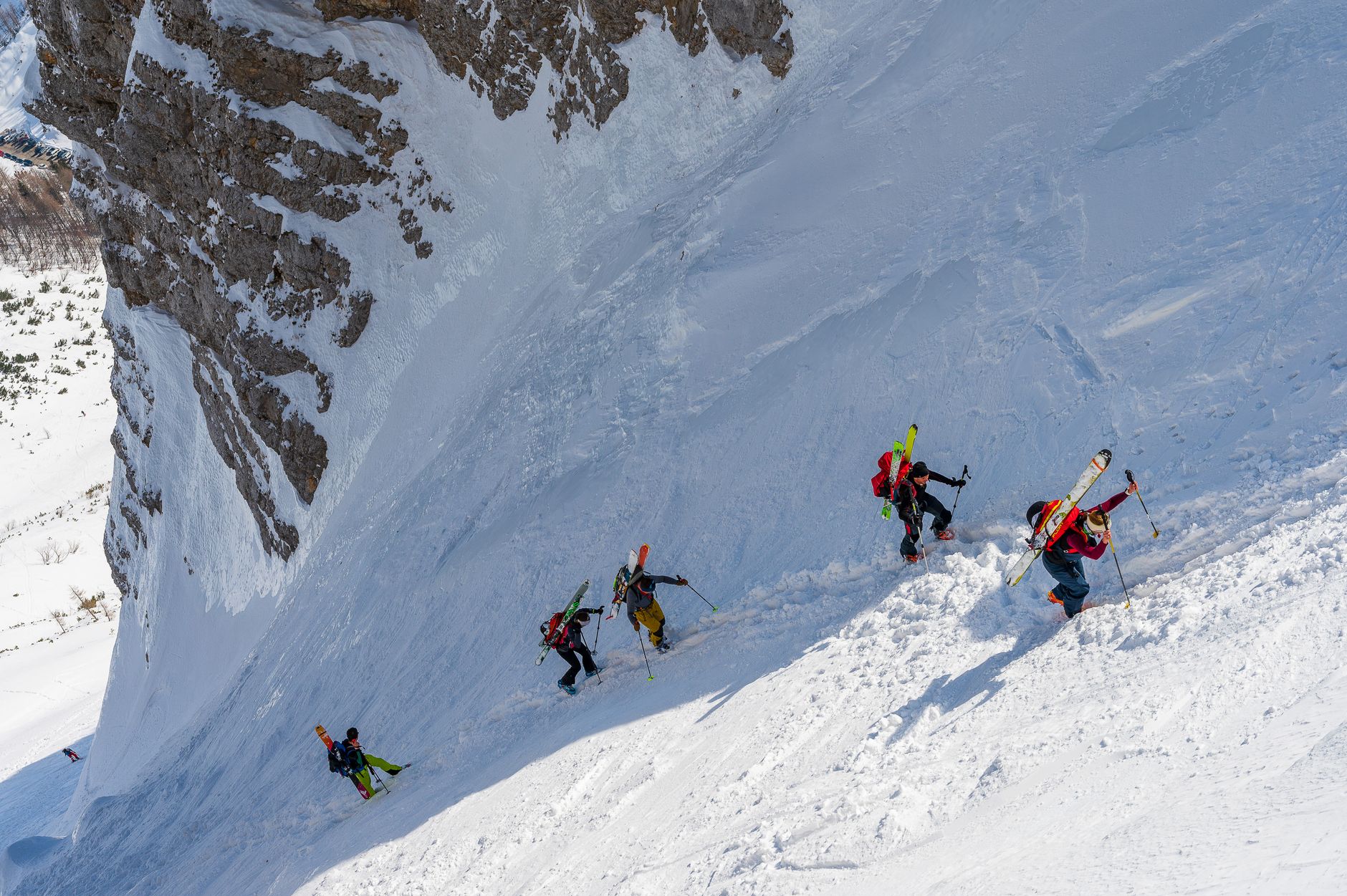
With Everest: The Other Side, Elizabeth Chai Vasarhelyi returns to chronicling people who choose to live on the edge, but shifts the focus from an individual feat to a more complex relationship between ambition, family, and responsibility. The documentary, directed alongside Jimmy Chin and presented at the 70° BFI London Film Festival, follows Hilaree Nelson and Jim Morrison in their bid to climb and then ski the North Face of Everest: a record-setting project requiring off-the-scale physical, technical, and mental preparation.
The film follows Free Solo, the 2019 Oscar-winning title that turned Alex Honnold’s ropeless climb into a global cinematic phenomenon. The connection between the two works is obvious: here too, the story stems from a fascination with a seemingly impossible goal and the necessity of filming it without falsifying what unfolds. Yet Vasarhelyi, speaking in London alongside producer Shannon Dill, described the new project as an exploration of the ethical implications of great ambitions, rather than a mere chronicle of an athletic test.
It is a meaningful distinction for contemporary adventure documentaries. The mountain alone provides striking imagery and an almost automatic narrative arc: preparation, approach, obstacle, summit, return. Everest: The Other Side, however, attempts to ground that arc in a more tangible reality. In Nelson’s case—an elite mountaineer and ski mountaineer at the peak of the discipline—the pursuit of the feat coexists with motherhood and the emotional weight such an expedition inevitably places on those closest to her.
A dream that is not sugarcoated
Vasarhelyi explained that she was struck by Hilaree Nelson’s candor. The mountaineer made no attempt to ennoble her obsession through comforting platitudes: Everest may hold no meaning for those watching from a distance, but to her it held immense significance. This perspective gives the film its most compelling ground. Ambition is neither framed as a virtue to be automatically celebrated, nor as a flaw to be condemned from the outside; it is observed as a force that shapes identities, relationships, and achievements, but one that always comes at a price.
For Vasarhelyi, this theme fits into an already recognizable directorial path. Her films often focus on individuals capable of dedicating almost absolute discipline to an exceptional goal. In Nelson's story, however, that tension takes on a specific perspective: the director was also able to get to know her in everyday life, through the relationship between their respective families and children, seeing a present mother as well as an athlete driven by a radical desire.
This does not mean using motherhood as an obligatory lens to explain an athletic career. Rather, it means not artificially separating the public figure from the individual. The documentary grapples with a practical question: what happens when excellence in a sport built on exposure to risk meets bonds that make that risk anything but private? It is a dilemma that concerns Nelson, Morrison, and those around them, but also the way cinema crafts its protagonists in the era of major sports documentaries.
After Free Solo, a larger and more exposed production
Shannon Dill, previously involved in Free Solo, described Everest: The Other Side as a project of exceptional scale even compared to her documentary experience. The production is backed by Walt Disney Studios, a factor signaling the film's positioning within a market where visually impactful non-fiction stories are increasingly conceived as cinematic events capable of reaching audiences beyond mountain enthusiasts.
The comparison with Free Solo is inevitable for industry reasons as well. That film proved that an adventure documentary can combine tension, accessibility, and festival prestige without sacrificing the precision of its sporting context. Everest further expands the symbolic and logistical scale: it is not only one of the most recognizable mountains in the world, but a place steeped in a history of attempts, accidents, high-altitude tourism, and debates over the commercialization of mountaineering.
In the case of this film, the north face and the ski descent are central because they define the scale of the challenge, but they do not exhaust the subject. Dill emphasized being interested in Nelson as a professional who reached the top not as an exception to be celebrated, but rather for the tangible quality of her journey as a mountaineer and ski mountaineer. An important nuance: the documentary avoids—at least in the intentions expressed by the filmmakers—turning her record into a generic motivational formula.
The production came about at a distinctive moment. According to Dill, the proposal arrived in late 2020, as the industry was emerging from the harshest phase of the pandemic. In that context, returning to envision a film built around a major journey and a physical feat also felt like a broadening of horizons after years of restrictions. The desire for a story of movement, however, does not replace the complexity of a project that must confront the reality of an environment where decisions carry immediate consequences.
The limits of spectacular storytelling
Mountain cinema depends on a delicate balance. On the one hand, it must make visible what normally remains remote: weather conditions, exhaustion, altitude, technique, uncertainty. On the other, it risks turning danger into sanitized spectacle, where every uncomfortable element is absorbed by the final triumph or the promise of ever more breathtaking imagery. The phrase chosen by Vasarhelyi to speak of “ethical complexity” signals the intent not to shy away from this tension.
Risk is not merely the dramatic material that makes a film compelling. For those who practice extreme mountaineering, it is a condition that affects expedition partners, family members, and support teams. For those filming, it also becomes a matter of representation: showing vulnerability without exploiting it, acknowledging determination without mythologizing it, and conveying the exceptional nature of an achievement without suggesting it is replicable or desirable for everyone.
This approach could set Everest: The Other Side apart within a genre that has carved out a significant presence across festivals, cinemas, and streaming platforms in recent years. Sports documentaries are no longer necessarily niche products: access to compelling protagonists, filming in inaccessible environments, and precise narrative construction make them valuable assets even for major studios looking to expand their non-fiction audience. Yet the growth of the format also heightens scrutiny of its language and the cultural models it puts forward.
The strength of the new film will therefore hinge on its ability to balance two competing demands. The first is maintaining the cinematic scale of an Everest expedition, with everything that entails in terms of landscape, anticipation, and danger. The second is avoiding reducing Hilaree Nelson and Jim Morrison to mere functional figures in a feat. Vasarhelyi and Dill's words suggest that the core of the narrative should lie precisely in that conflict: the clarity required to pursue an extraordinary achievement and the awareness of how much that choice impacts others.
At the BFI London Film Festival, Everest: The Other Side therefore presents itself as a test of the legacy of Free Solo. Not simply an attempt to raise the adrenaline bar, but a work that uses the scale of Everest to question the allure, the discipline, and the unresolved side of ambitions that seem to brook no compromise.