Tackling the invasion of Iraq and the manhunt for Saddam Hussein means stepping into territory that American fiction has frequently explored, not always with results worthy of the subject matter. High Value Target: The Hunt for Saddam, an eight-part TNT miniseries, chooses a relatively narrow window into that era: the perspective of John Nixon, a CIA analyst and the first agency official to interrogate the Iraqi president following his capture in December 2003.
It is a vantage point that promises political tension and moral ambiguity. Nixon, played by Joel Kinnaman, is not a front-line soldier but an Iraq expert eager to step out from behind a desk and prove his worth. His opportunity coincides with the U.S. military operation that leads to Hussein’s capture and, later, the chance to sit across from the man Washington had designated as one of the primary targets of the war.
The series is adapted from Debriefing the President, the book written by Nixon himself, and this connection explains both the project’s appeal and an inherent structural limitation. On the one hand, the narrative can zero in on procedure, internal rivalries, and the relationship between intelligence and political power. On the other, it tends to keep its protagonist at the center even when the surrounding figures and historical implications prove more compelling than he is.
The hunt takes a backseat to the interrogation
The subtitle suggests a story revolving primarily around the operation to track down Saddam Hussein. In reality, his capture does not occur until around the midpoint of the third episode; the early stretch is spent establishing the context of the invasion, Nixon’s ambitions, and friction within the American apparatus. The creative choice is not without merit, as without that backdrop the interrogation would risk feeling like an isolated duel. Even so, the build-up leading to the arrest struggles to generate sustained tension.
The reconstruction alternates between archival footage and fictional scenes, also evoking the George W. Bush administration's rhetoric on weapons of mass destruction. It is an essential element: the question of weapons, which was supposed to legitimize the war, becomes one of the focal points of the face-off between Nixon and Hussein. The problem is that many sequences dedicated to summits, meetings, and professional clashes remain within the familiar tropes of the television political thriller. Characters discussing strategy in a conference room and a protagonist who must convince hostile superiors are not enough, on their own, to convey the complexity of a war whose consequences remain evident today.
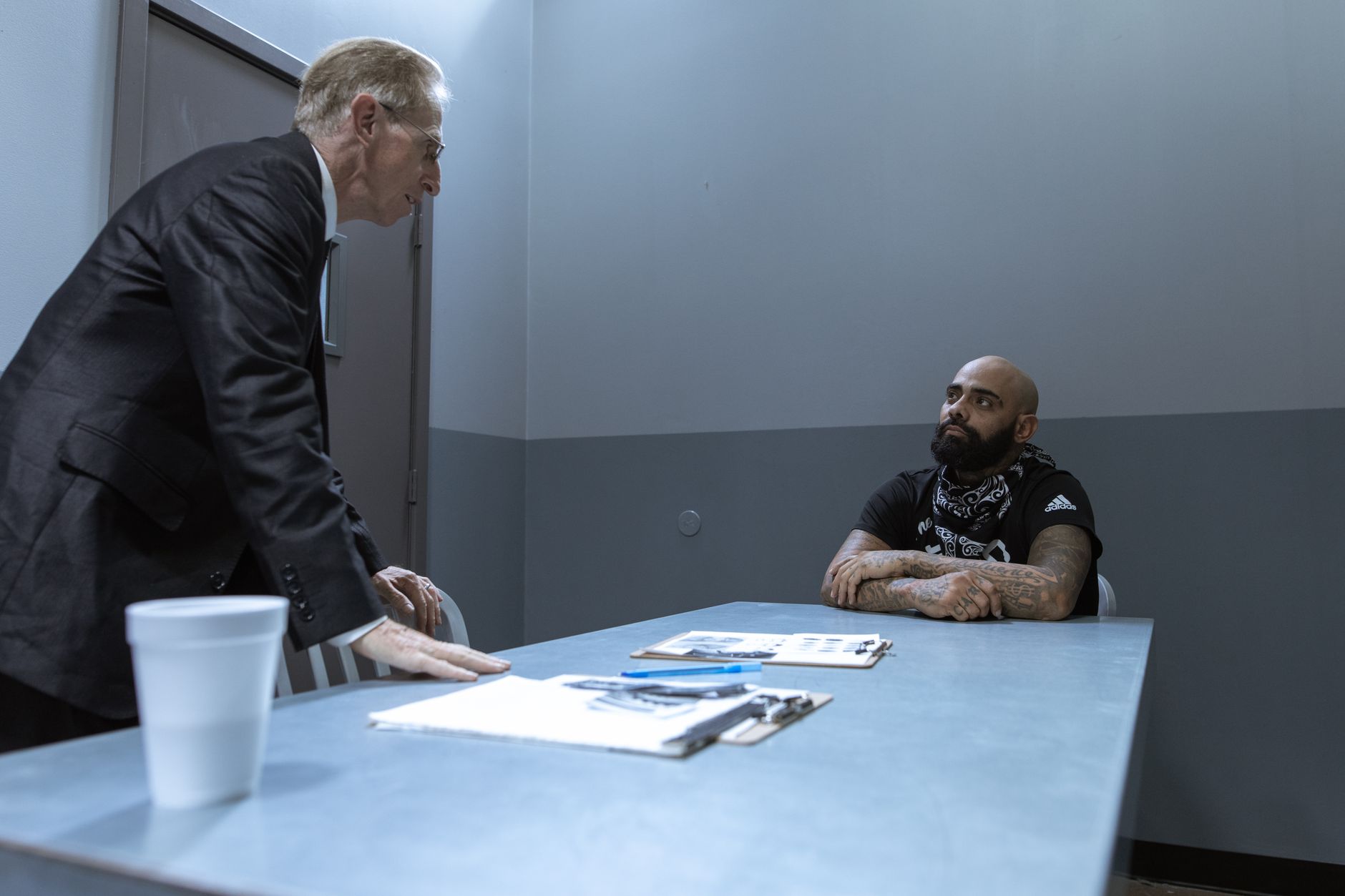
The series seems to gain precision when it abandons bureaucratic dynamics to focus on the interrogation room. There, there is no longer any need to insist on stated stakes: it is enough to watch two men measure their words, test each other's account, and try to establish who truly holds control of the conversation. Nixon seeks intelligence and validation for his mission; Hussein uses his experience of power to turn detention into a final battleground for psychological negotiation.
Waleed Zuaiter shifts the series' center of gravity
It is primarily Waleed Zuaiter who makes this change of pace believable. Playing Saddam Hussein comes with an immediate risk: reducing him to a caricature of a tyrant or, conversely, mistaking the pursuit of complexity for an absolution. Zuaiter avoids both shortcuts. His Hussein retains the weight of a figure responsible for a brutal regime, yet is not treated as a mere cutout serving American certainties. He is elderly, vulnerable, and imprisoned, without ever ceasing to exert charm, authority, and manipulative skill.
This performance lends the scenes with Kinnaman a density that the rest of the miniseries often lacks. In particular, the dialogue regarding the alleged presence of weapons of mass destruction brings back to the fore the historical paradox on which the invasion was built: Saddam cannot escape responsibility for his past, but the United States must reckon with the public justifications for its war and with what it ultimately failed to find on the ground.
Kinnaman brings to the screen a restless and determined Nixon, but the writing does not always offer him the tools to move beyond the narrative role of a man who finally wants to matter. Conflicts with his father Charles, a veteran played by Tom Berenger, and with CIA superiors define his need for validation, as does his family life with his wife Rebecca, played by Rebecca Night. These storylines are meant to build the man behind the analyst, yet they tend to make explicit what the performance alone could suggest. The character thus remains less compelling than the adversary he interrogates.
Another element broadening the perspective comes from Samir, the soldier played by Dar Salim and a member of the team that captures Hussein. His role takes the series beyond the corridors of intelligence and serves as a reminder that history belongs not just to Washington documents or Nixon's personal account. In moments when it makes room for this perspective, High Value Target manages to connect the American military machine, Iraqi territory, and the personal repercussions of a geopolitical operation.
A story too large for a familiar formula
The main limitation is not the ambition to tackle a controversial historical case, but the uneven way the miniseries distributes its weight. The work aims to trace the manhunt, detention, trial, and execution of Hussein, alongside the diplomatic and human repercussions of the invasion. It is expansive subject matter, spanning years and involving institutions, armies, and populations. Across eight episodes, however, the accumulation of themes does not always yield a richer picture: at times, it merely dilutes the narrative.
The choice to push all the way to Saddam Hussein's execution, also recalling the existence of clandestine footage of his death, makes it clear that the goal is not merely to chronicle a military operation. The series seeks to interrogate the aftermath of the American victory, including the gap between the tactical success of the capture and the stability promised by the intervention. It is here that the project finds its most compelling argument: not Nixon's transformation into a hero, but the impossibility of concluding a war through the capture of a single man.
For TNT, a title like High Value Target also shows just how delicate revisiting the War on Terror can be in contemporary audiovisual media. Audiences are already familiar with the imagery, the outcomes, and the fractures produced by that era; a narrative that merely replicates the lexicon of the patriotic thriller risks feeling outdated. The miniseries partly avoids that trap when it allows Hussein, Samir, and the consequences of the occupation to complicate the American perspective. It falls back into it when it devotes too much energy to conventional professional and domestic beats.
The result is a production with a solid dramatic core, but one that is not always capable of sustaining it. Those looking for a linear chronicle of the capture will find a broader story, focused primarily on the months and years that followed. Those interested in the clashes between intelligence, power, and political memory will instead find the strongest material in the scenes between Kinnaman and Zuaiter. Those moments hint at the potential of a series that, without resolving all of its contradictions, tries to look beyond the narrative of a mission accomplished.