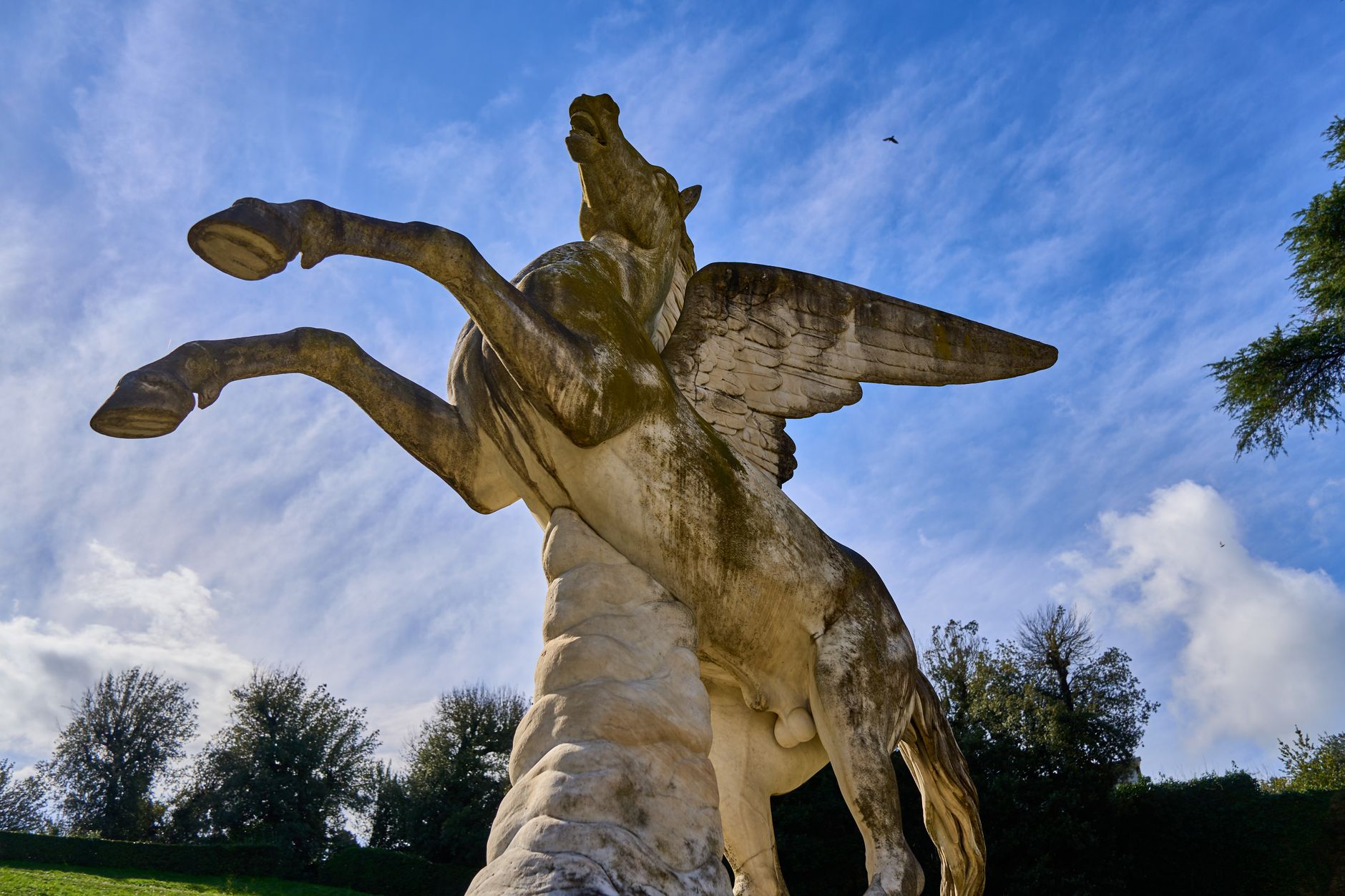
In Librino, a neighborhood on the southern outskirts of Catania, the museum is neither a building nor a collection bounded by opening hours and tickets. Instead, it continues to grow within everyday spaces, along schools, overpasses, and the routes residents walk each day. The latest addition is Pegaso, a work by artist Antonello Bonanno Conti, which has joined the MAGMA project alongside five thousand clay tiles engraved by local mothers and children.
The initiative is part of a thirty-year relationship between Librino and Antonio Presti, an entrepreneur and patron of the arts from Catania, founder of Fiumara d’Arte and Atelier sul Mare. Once again, the approach is not to install an artistic artifact as an alien element in the context: the winged horse was created through a process that involved the Campanella-Sturzo school complex and local families. The tiles bring together words, symbols, and wishes entrusted to the direct touch of those who live in the area.
It is a crucial detail for understanding the project. In a neighborhood often portrayed almost exclusively through social hardship, waste, and crime, the new work attempts to shift attention to a heritage built over time and to the residents' ability to be authors, rather than mere recipients, of cultural action. The presence of the tiles is therefore not a decorative frame for the sculpture: it brings into the artwork a part of the community that accompanied it.
A public artwork born from the neighborhood
Pegaso is presented as a figure of light and as a symbol dedicated to children's dreams. Surrounding the work, the five thousand tiles capture very concrete aspirations: friendship, health, determination. A poetic text by Maria Attanasio also appears on the overpass, anchoring the installation to the urban landscape in which it is set.
Involving children and parents changes the meaning of the word participation, all too often used to describe activities secondary to decisions that have already been made. Here, the hands-on contribution becomes a permanent part of the outcome. Over the years, the people who engraved the clay will be able to recognize their own mark within a public space, while for the school, the work can endure as a visible trace of a shared experience long after the workshop ends.
On its own, this does not resolve the issues affecting a large urban periphery. It would be inappropriate to assign to an artwork functions that belong to public services, maintenance, education, transport, community spaces, and labor policies. Yet a deeply rooted cultural practice can influence how a place is perceived and experienced, especially when it does not arrive as an isolated event. Its effectiveness depends on continuity, care, and the likelihood that those living in the neighborhood consider it their own.
MAGMA, a collection without borders
The new installation joins the MAGMA diffuse museum, the project spearheaded by Presti in Librino. In this case, the concept of a diffuse museum is not merely about the physical dispersal of artworks: it challenges the divide between exhibition space and urban life. The neighborhood's streets and infrastructure become the support and context for a heritage accessible without mediation.
Works already tied to this initiative include Porta della Bellezza, Porta delle Farfalle, and contributions by artists such as Neri and De Nisco. This layering is crucial because it prevents viewing Pegaso as an inaugural episode or as an isolated beautification effort. Librino now possesses a collection of artistic landmarks accumulated over the years, with a distinct profile that can foster both a sense of belonging and external interest.
The model also carries urban planning and cultural significance. Peripheral areas are often engaged by public art through temporary initiatives, murals, or installations of uncertain lifespan. By contrast, the work launched in Librino aims for permanence, shaping a cultural geography in which the artworks do not erase the neighborhood's identity, but rather engage its people, schools, and infrastructure as counterparts. This brings an equally permanent responsibility: safeguarding what has been created, keeping it intelligible, and protecting its meaning over time.
According to data cited in the project, Librino has around 70,000 residents, 10,000 of whom are children. These figures explain why the educational dimension cannot be considered secondary. In such a large community, the relationship between art and schools can turn a visual intervention into an opportunity for civic engagement: not because a sculpture alone can change the material conditions of an area, but because it offers common ground on which to build recognition and responsibility.
From beauty to the need for a stable framework
The story of Pegaso comes at a juncture where the future of MAGMA is also being addressed at an institutional level. Last July, Presti presented the Librino experience to the Commissione parlamentare sulle periferie della Camera, expressing hope that the work can continue within a more structured framework. The reference highlights a tangible issue: long-term cultural projects may stem from the initiative of individuals, but to avoid relying solely on their energy, they require public dialogue, resources, and organizational continuity.
For Catania, the challenge is therefore not just about unveiling a new artwork. It concerns the ability to recognize the diffuse museum as part of the city, along with the demands this entails: the upkeep of public spaces, the preservation of artifacts, attention to schools, and the enhancement of a heritage that is not concentrated in the historic center. The risk, in the absence of this continuity, is that the works remain left to the goodwill of those who championed them and those who live alongside them every day.
Yet Librino offers a useful case study well beyond Catania's borders. When public art is built on lasting relationships, its value is not measured solely by the final image or the artist's profile. What matters is the process that enables a community to recognize itself in a place and reclaim it from a reductive narrative. The five thousand tiles beside Pegaso make this transition literal: an artwork may bear an artist's signature, but the cultural landscape it becomes part of remains a collective effort.