An eighteenth-century villa on the outskirts of Napoli becomes the meeting place for Japanese cuisine, music listening, and a cocktail bar. In Portici, inside the spaces of Villa Pagliano, Mihao has opened, a project born from the initiative of six friends who chose to build a venue with a precise identity: neither a traditional Japanese restaurant nor a themed bar, but a listening bar where sound is an integral part of the table experience.
The format fits into a trend that in recent years has brought renewed attention to listening-focused venues, partly inspired by Japanese jazz kissa: spaces where music is carefully curated and reproduced, rather than remaining an indistinct background. At Mihao, this component is powered by a tube sound system and vinyl programming, elements that define the venue's atmosphere as much as the offerings at the counter and in the kitchen.
The choice to locate such a project in Villa Pagliano also shifts the narrative away from the usual addresses in the center of Napoli. Portici, a town overlooking the Gulf and part of the Vesuvian area, finds in this opening a venue designed for the evening hours but built on a formula that brings together multiple dining and drinking occasions: aperitivo, informal dinner, and after-dinner drinks.
A Japanese menu designed for the bar
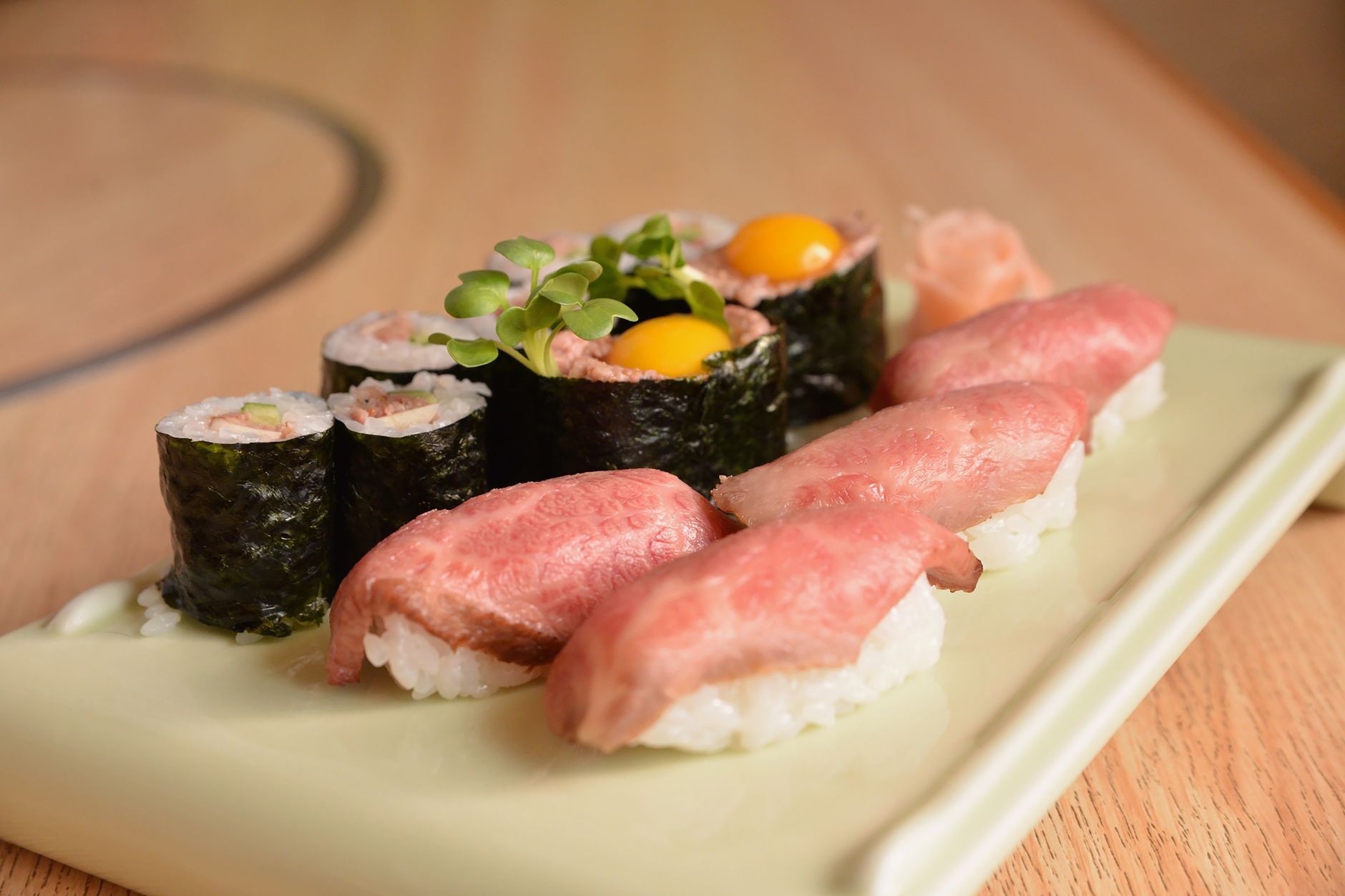
The kitchen follows the same hybrid logic. The menu looks to Japan through preparations well-suited for sharing and bar-style service: onigiri, gyoza, and takoyaki are among the featured offerings, alongside sushi. It is therefore not an offering structured around a formal sequence of courses, but a selection tailored to flexible dining times, from a bite with a drink to a light dinner.
It is an important detail from a dining perspective. In a market where the "Japanese" label is often associated almost exclusively with sushi, the presence of snacks and street food expands the culinary vocabulary on offer, without claiming to be an encyclopedic journey through Japanese gastronomy. Onigiri and takoyaki, in particular, help bring the menu closer to the convivial dimension that Mihao appears to pursue: manageable, immediate, recognizable food that fits seamlessly with dining at the counter.
The drinks menu also follows Japanese inspiration. Pairing cocktails with Asian cuisine is not entirely new in major cities, but in this case, it is tied to the very nature of the project: mixed drinks are not treated as a marginal complement to the food offering, but rather as one of the three pillars supporting the venue, alongside music and cuisine.
Why the location is part of the project
Opening in a historic villa gives Mihao a setting far removed from the urban, minimalist aesthetic often associated with contemporary listening bars. The context is not just a container: the decision to repurpose and inhabit spaces that already boast their own distinct identity helps turn the venue into a destination address, worth visiting for the setting as well as what is on the menu.
For Portici, this venture signals a search for formats capable of engaging diverse audiences without relying on the traditional large-restaurant model. The city boasts a historical heritage and a location closely linked to Napoli, but establishing an independent nightlife scene also relies on the variety of its offerings. A venue combining light dining, mixology, and listening can extend dwell time and multiply the reasons for a visit.
The presence of six friends as business partners behind the launch also reflects an entrepreneurial model common among new independent businesses: a project born out of a close-knit community with a shared vision, seeking to differentiate itself not through scale, but through the consistency of the experience. In a highly competitive sector, where new openings follow in rapid succession and the cost of capturing attention is high, having a clearly legible identity can carry just as much weight as the quality of the offering itself.
Listening as a service, not a backdrop
The definition of a listening bar must be taken seriously, as it implies a shift in the relationship between the venue and its clientele. Vinyl records and a tube-amplified sound system demand a more deliberate management of volume, repertoire, and the pacing of the evening. The expected result is not merely the creation of a recognizable playlist, but an environment where sound contributes to conversation, the rhythm of service, and the lasting memory of the experience.
This type of setup can be an advantage, but it also carries an operational constraint: the balance is delicate. The music must remain prominent enough to define the venue's character, without turning dinner and cocktails into an uncomfortable experience for those seeking a meeting or conversation. In the same way, the culinary offering must support the format without being perceived as a mere accessory. Mihao's long-term viability will depend on its ability to make these elements coexist in daily operations, not just in the initial launch narrative.
For guests, the appeal lies precisely in the option to choose a less standardized experience. Contemporary dining is increasingly focusing on the surrounding context: lighting, music, design, hospitality, and menu language factor into the overall impression just as much as the food on the plate. Mihao introduces this dynamic to a location off the beaten track of Neapolitan dining, housing it within a historic building with cultural references that are distant yet now familiar to a significant portion of urban clientele.
A signal for dining in the Neapolitan area
The launch should not be viewed as a revolution of the local market, but rather as a useful signal of its evolution. The boundaries between bar, restaurant, and cultural venue are becoming less rigid: an establishment can build its value around culinary specialization, a beverage list, artistic programming, or, as in this case, the intertwining of all these components.
For hospitality operators, examples like Mihao demonstrate how much it matters to design an offering tailored to the location and the consumption moment. The Japanese reference does not stop at the menu; it extends to the listening culture and the overall concept of the bar. On the other hand, the villa in Portici prevents the format from feeling mechanically replicable: it is the convergence of a specific building and a vision of hospitality that gives the project its distinct identity.
In the coming months, the audience's response will gauge the resilience of this formula. For now, Mihao adds a new destination to the gastronomic map of the Vesuvius area, placing front and center an element that dining often overlooks or leaves to chance: the way one listens, alongside the way one eats and drinks.