One question runs through Giovanni Lena’s work and seems to belong to an entire era: how do we find a direction when the future no longer appears as a promise, but as something to decipher? The young writer, director and performer has chosen theatre to explore it. At the heart of his production is an apparently ordinary figure, Milo, a young man from Generation Z and the protagonist of $W1$HLAND (o l’orizzonte di senso in un mare di nebbia), which comes to Rome’s Teatro Hamlet on 10 and 14 December 2026. The Italian subtitle evokes a horizon of meaning in a sea of fog.
Written by Giovanni and Francesco Lena and produced by Artenova, the play is the only title scheduled for two evenings in the eleventh edition of EXIT – Emergenze per identità teatrali. It is an opportunity to discover an artistic project that does more than treat young people as a subject: it turns their everyday lives into dramatic material. Its protagonist need not accomplish anything extraordinary to deserve our attention. A single day in his life, and the difficulty of deciding what it means, is enough.
Giovanni Lena: choosing to write, direct and perform
To understand Lena’s work, it helps to begin with the responsibilities he takes on in this production. He is not merely the face audiences will encounter onstage. He also co-wrote the play with Francesco Lena and directs it. This triple perspective places the relationship between language, the body and space at the centre of the project: the person imagining the story must also make it visible and sustain its tension in front of a live audience.
Publicly available biographical information about the artist remains limited, but EXIT’s programme provides a precise account of this particular work. Combining writing, directing and performing involves a distinctive form of artistic exposure. A writer can entrust their voice to another performer; a director can observe the results of their choices from outside. Lena assumes both roles while placing his own body at the centre of the theatrical device. It is the work itself, rather than an extensive résumé, that offers the clearest way into his artistic exploration.
Twenty-four hours in Milo’s life
The narrative takes place over a single day, in the space of a theatre. Connecting these two dimensions is a story organised into six scenes, framed by an opening and a conclusion. The official presentation announces a single performer and an unsettling presence that may interrupt the protagonist’s experience. The nature of this figure is not revealed in advance, leaving room for different interpretations.
The choice of a twenty-four-hour timeframe is significant. When an entire generation is described through major events, individual lives can disappear behind collective phenomena. Narrowing the focus to a single day allows life to be observed at its most tangible scale. Drama can arise not from a catastrophe, but from the repetition of ordinary gestures, our relationship with time and the distance between what we want and what we can imagine.
As presented, Milo is no generational hero. He is an ordinary young man. That very ordinariness makes him interesting: one does not need to be exceptional to face fundamental questions. The search for meaning does not necessarily come at the end of a great adventure. It can accompany waking up, waiting, meeting other people and returning home.
Desire in an age of permanent connectivity
The title offers another possible way into the play. The stylisation of $W1$HLAND, using dollar signs and a numeral in place of a letter, visually evokes the codes of digital culture. Its subtitle introduces an almost opposite image: a landscape in which fog makes the horizon impossible to see. The contrast suggests a possible interpretation, without claiming to know intentions the authors have not stated.
It is possible to live in a world overflowing with information, images, comparisons and models of success while still not knowing where one wants to go. Having many options is not the same as being able to choose. Personal identity can become a project that needs constant updating, while desire risks becoming confused with what others expect from us.
Theatre offers a particularly interesting place to explore this contradiction. In the auditorium, time is not something to scroll through: it is shared with other spectators and shaped by the presence of a real human body. The stage cannot solve the contradictions of the present, but it can briefly remove them from the noise of instant explanations. In that suspension, Lena’s work invites a contemporary reading.
A generation that is more than a statistic
Young people’s uncertainty should not become another cliché about Generation Z. They are not a homogeneous group, and not everyone experiences the future with the same fear. An Istat study published in April 2026, based on data collected in 2023 among 11- to 19-year-olds, found that 41.3% looked towards the future with curiosity and confidence, almost a third with fear, and 17% preferred not to think about it. These figures apply to a specific age group, not all young adults, but they illustrate the diversity of expectations within a generation.
The issue is not merely emotional. Entering the labour market, securing independent housing, choosing an educational path and maintaining meaningful relationships all involve a combination of material opportunities and personal expectations. None of these conditions can automatically be attributed to Milo or to the performer’s own biography. Rather, they provide a wider context in which a work about finding direction may resonate.
The merit of Lena’s dramatic premise is to offer an individual point of view: before asking what young people think, observe what happens to one young person. The difference is far from trivial. The first question risks producing a definition; the second opens up a narrative space where contradictions can exist.
Behind a solo performance, a collective creative effort
Giovanni Lena’s central role should not obscure the collaborative dimension of the production. Francesco Lena, in addition to co-writing the work, is assistant director and shares set design credits with Sonia Trionfetti. Lighting is by Leandro Moussavou, music by Vittorio Giannelli and stage movement by Marzia Meddi. The production is by Artenova.
These credits help explain the project’s formal ambitions. In a work entrusted to a single performer, movement, light, sound and space can contribute to the creation of multiple atmospheres. The actor’s body becomes the meeting point of different artistic languages rather than a substitute for them. The official description emphasises the physical dimension of the experience, humorously evoking the exertion of a marathon. This indicates the kind of involvement the project intends to offer, rather than a verdict on the performance itself.
EXIT and the value of Rome’s independent theatre scene
Teatro Hamlet, at Via Alberto da Giussano 13 in the Pigneto area, hosts EXIT from 7 to 14 December. Seven works over eight evenings, supported by Italy’s Ministry of Culture, the Lazio Region and ATCL, in collaboration with FED.IT.ART. The programme offers a range of perspectives: from intimate relationships to economic crises, historical memory, the language of news and collective rituals.
For a city such as Rome, the value of a festival like this is not simply an expanded choice of performances. Urban culture needs places where ideas can be tested before becoming established products, where a young artist can meet an audience, and where audiences can discover less predictable forms of expression. Independent theatres help make the city a place where culture is produced, not merely consumed.
In this context, the two performances of $W1$HLAND, including the closing night, provide Lena’s work with a tangible opportunity for visibility. There is no need to turn that opportunity into a coronation to recognise its significance: being seen is one of the essential conditions for artistic research to develop.
An artist to watch, a question to take beyond the theatre
Giovanni Lena’s work deserves attention for the way its premise connects an intimate question with a collective issue. The search for meaning can seem abstract; bringing it back to twenty-four hours in a young man’s life is an attempt to give it form, rhythm and vulnerability. The challenge will be to see how the transition from writing to performance makes that tension perceptible without turning it into an argument with a predetermined answer.
The potential strength of theatre lies precisely in its freedom not to conclude with a solution. Not every anxiety requires a moral, and not every character must become an example. Sometimes a work matters because it restores dignity to a question we have stopped asking. That is the most intriguing promise of Lena’s project: to let an experience speak, allowing spectators to recognise something of themselves within it.
Where and when to see $W1$HLAND
The two performances are scheduled for Thursday 10 and Monday 14 December 2026, both at 9 pm, at Teatro Hamlet in Rome (Via Alberto da Giussano 13). Admission is free, with compulsory membership and online booking. Information and reservations are available on the Teatro Hamlet website. The programme and artistic credits can be found on the official ATCL page; admission information is also reported by Volwer and il Tacco di Bacco.
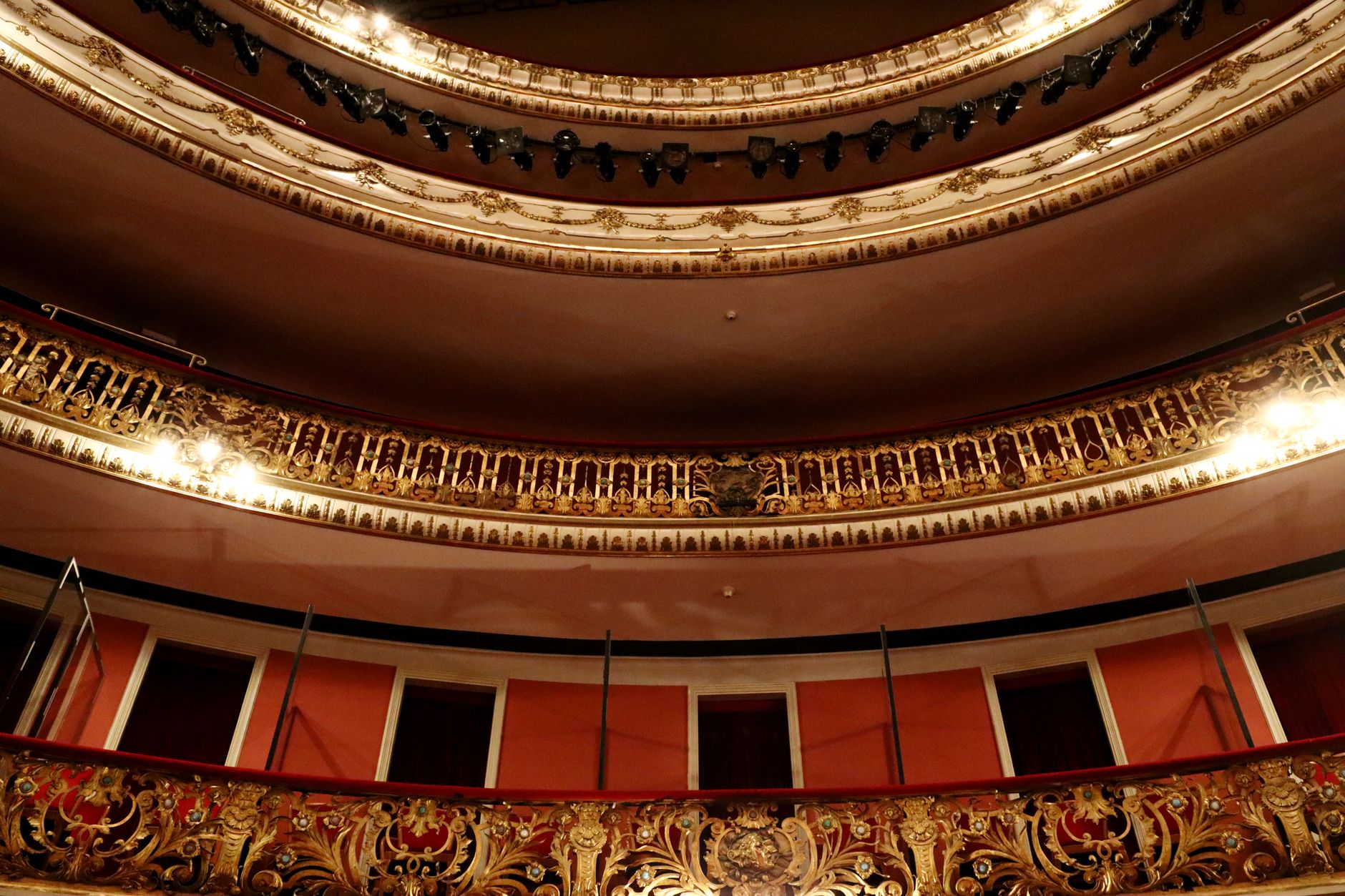
Cover image: illustrative photograph of a theatre stage, not a photograph of Giovanni Lena or the production. Photo: Martin de Arriba / Pexels.