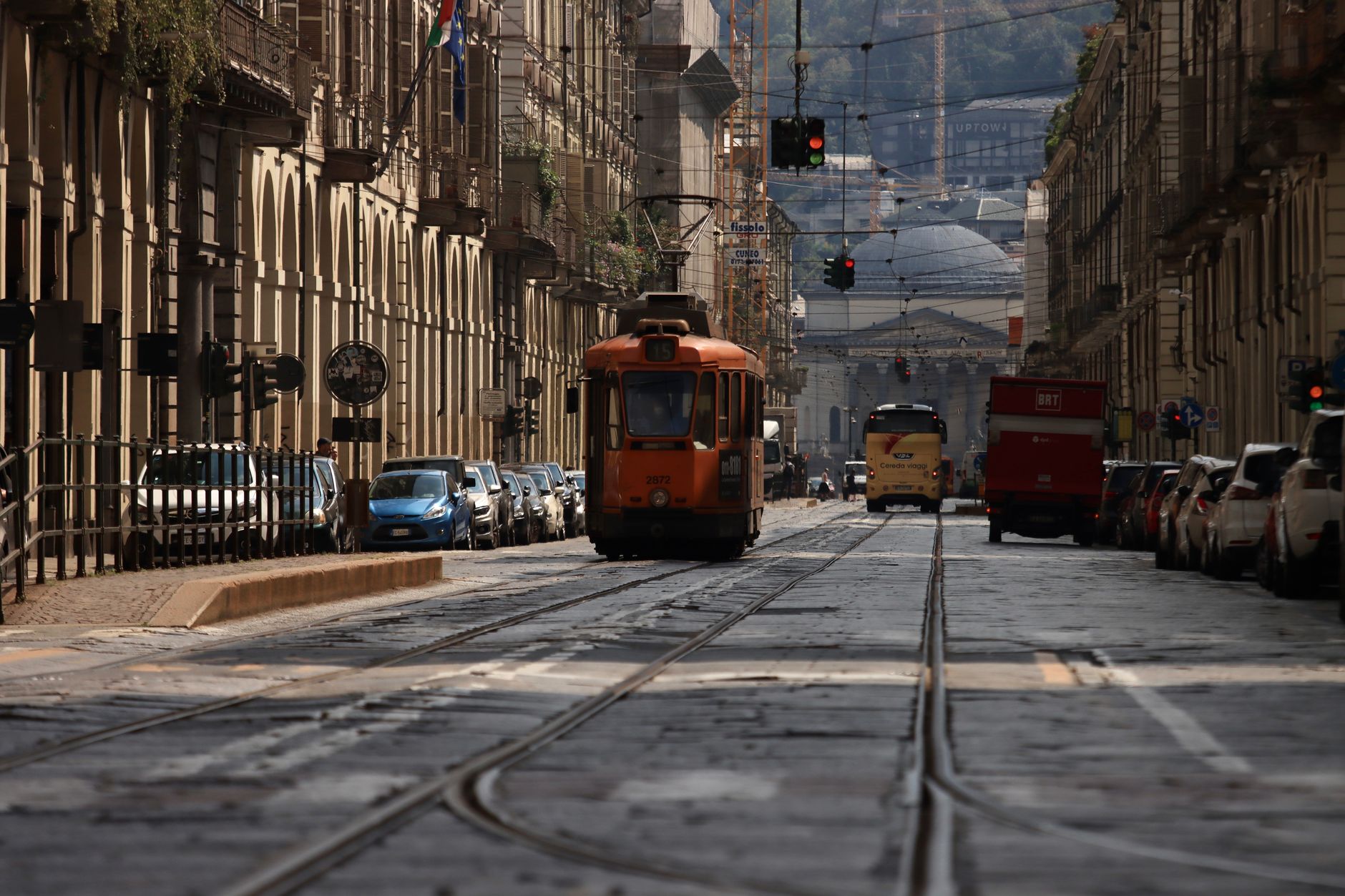
Torino has restored tram line 4 across its entire route to Falchera, completing an important milestone for one of the city's longest and most strategic public transit corridors. With the new loop and the deployment of high-capacity Hitachi Rail trams, the line once again spans approximately 18 kilometers, connecting peripheral neighborhoods and central areas along a corridor that, for thousands of people, represents far more than a simple alternative to driving.
TorinoToday documented the return of full service and the arrival of the most modern vehicles in the heart of Falchera. The seemingly technical milestone—a tram returning all the way to its terminus—takes on broader urban planning significance because it concerns the accessibility of a suburban district to the citywide network. In a compact city marked by stark spatial disparities, the quality of public transit directly dictates how close a person is to work, school, healthcare, and essential services.
Eighteen kilometers are a social geography
Long tram lines have a distinct characteristic: they cross different cities within the same city. They connect residential neighborhoods, rail hubs, commercial districts, hospitals, schools, and the city center. Torino's line 4 is one of the clearest examples of this role. Its value is measured not just in ridership figures, but in the continuity it establishes between areas with starkly different opportunities.
When a section is interrupted or the terminus is cut back, the consequences are unevenly felt. Those who live near a metro line or own a car have alternatives; those who rely on public transit must contend with additional transfers, longer waits, and uncertainty. Restoring the complete route therefore curtails a form of urban cost that rarely shows up on balance sheets: lost time.
New trams boost capacity and accessibility
Modern high-capacity vehicles do not merely transport more people. They can offer low floors, climate control, real-time information, greater interior space, and improved passenger flow management. These features fundamentally reshape the travel experience for seniors, people with disabilities, families with strollers, and rush-hour commuters.
The real test will be reliability. A high-capacity yet irregular tram can cause as much waiting and crowding as a smaller vehicle. Frequency, traffic light priority, maintenance, and incident management along the route are all part of the same system. Infrastructure works when hardware and organization support each other.
Falchera is where mobility becomes urban policy
Bringing modern transit to the suburbs also carries symbolic value. For decades, many European cities concentrated their most visible investments in city centers, leaving outer neighborhoods with older vehicles and less frequent service. The result is the perception of a two-tier citizenship.
Line 4 partially overturns this logic because a high-capacity corridor reaches Falchera directly. It does not solve all the neighborhood's problems, but it gives concrete form to the principle that distance from the center should not mean distance from services.
The tram is experiencing a second life in Europe
Many cities that scaled back their tram networks in the 20th century are once again investing in surface rail. The reason is practical: compared to a subway, a tram generally requires lower capital investment and shorter construction timelines; compared to a bus, it can offer greater capacity and a sense of permanence that also guides real estate development and economic activity.
It is not a perfect technology. It often shares space with traffic and intersections, can be vulnerable to accidents, and requires tracks and dedicated maintenance. But along high-demand corridors, it offers an effective balance between capacity, cost, and urban quality.
Commercial speed remains the real challenge
To convince drivers to leave their cars behind, a new tram is not enough. Travel times must be competitive. This is where dedicated lanes, smart traffic lights, and intersection design come into play. Every minute lost behind a parked vehicle or an unnecessary signal cycle diminishes the return on investment.
The cities achieving the best results treat the tram as priority infrastructure, not as a bus on rails forced to endure traffic. Torino now faces a second phase: having restored the route, it must now maximize its regularity and speed.
Line 4 can become a backbone for other services
A strong backbone works best when fed by a network of local connections. Neighbourhood buses, bike paths, pedestrian routes, and park-and-ride facilities can converge on stops, enabling more people to take the tram for the main leg of their journey. It is the principle of hierarchical networks: not every route needs to go everywhere, but hubs must be easy to reach.
For Falchera, this means designing the last mile with the same care devoted to the transit vehicles themselves. Lighting, safety, sidewalk accessibility, and real-time information at stops determine how much the infrastructure is actually used.
Public transit is also housing policy
When a neighbourhood is well connected, its economic distance from the rest of the city shrinks. This can improve access to opportunities and make less central areas more attractive. However, it can also drive up property values and generate new pressures. This is why transit and housing policies should be conceived together.
An efficient line can allow a family to live farther from the city centre without sacrificing hours of their day. At a time when housing affordability is one of Europe's major urban crises, mobility becomes part of the solution: not because it automatically makes housing cheap, but because it expands the amount of the city that is genuinely accessible.
Success will be measured in everyday habits
The inauguration or restoration of a line generates photo ops and statements. Urban quality is measured months later, when the service has to run in the rain, during peak hours, and on ordinary days. If the tram arrives reliably, is clean, safe, and faster than driving for many trips, people's behaviour changes without the need for ideological campaigns.
The return of linea 4 all the way to Falchera is therefore a local story with a broader lesson. Cities do not become more inclusive solely by building mega-projects. Sometimes it is enough to make an existing line run exceptionally well, extend it where needed, and deploy the best rolling stock even at the edge of the map. Eighteen kilometres of track may seem like a technical detail; for those who ride them every day, they are a tangible measure of how truly united the city really is.
Sources