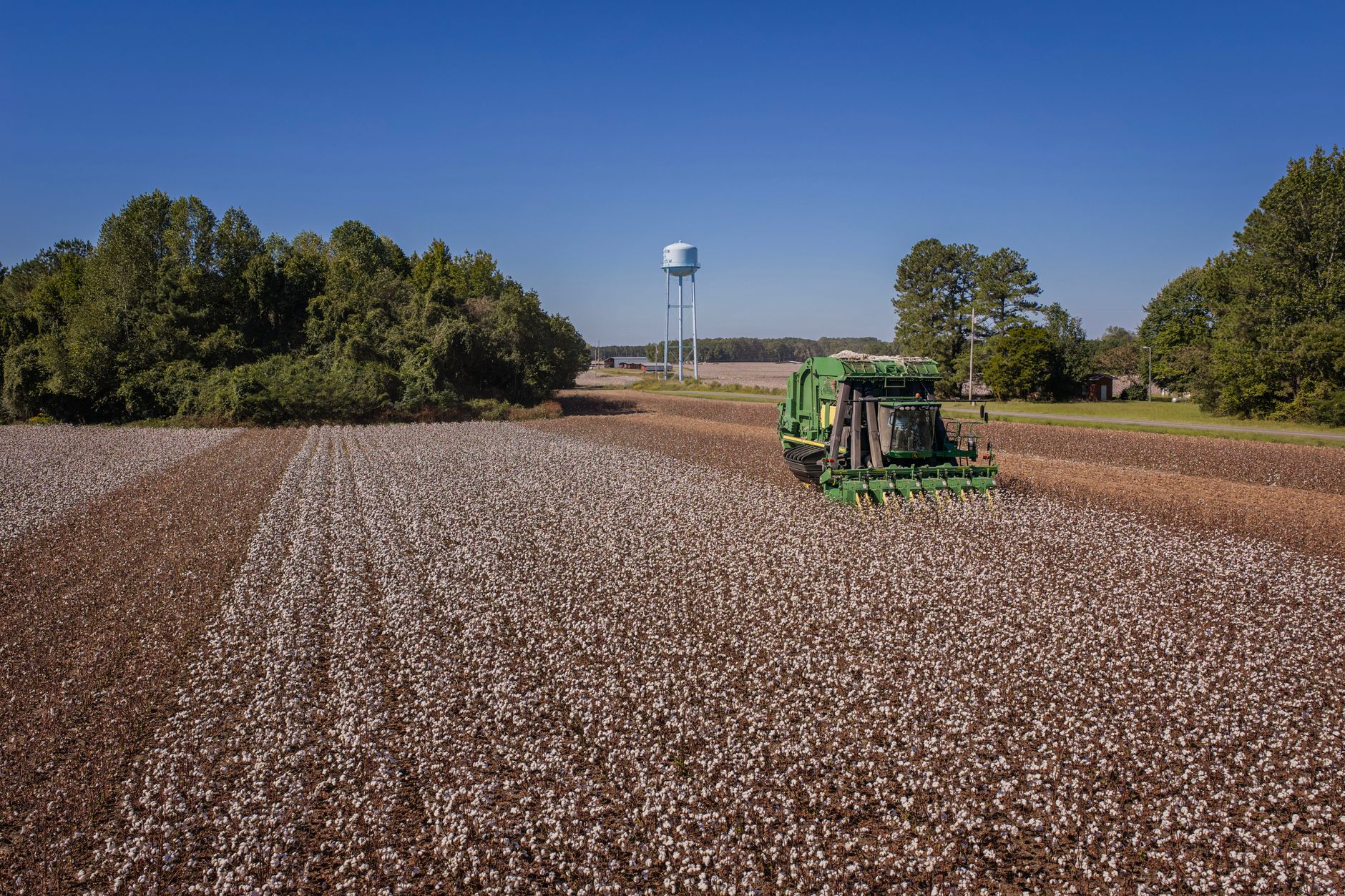
Fashion sustainability begins long before garment manufacturing, the price tag, or the promise of recyclability. For cotton, one of the fibers that continues to define everyday wardrobes as much as denim and sportswear, the first crucial juncture is the field. And from the United States comes an update that directly impacts brands' sourcing strategies: American growers are reporting measurable improvements in water, soil, and land use, while a life cycle assessment funded by Cotton Incorporated credits the fiber with a net-negative emissions balance from cultivation to ginning, under specific methodological conditions.
The United States remains among the world's largest cotton producers. Its relevance to fashion does not rely solely on volume: in a supply chain facing mounting pressure over traceability, environmental impacts, and raw material availability, agricultural origin is becoming a concrete factor in purchasing decisions. For brands and retailers, choosing a fiber is no longer just about selecting hand feel, price, and industrial yield. It also means being able to document how that raw material was produced and what potential for improvement it retains over time.
Four decades of agricultural practices under observation
According to Cotton Incorporated's 2023 National Resource Survey, over the course of roughly forty years, cotton farming in the United States has reduced soil loss by 45%, increased irrigation water-use efficiency by 58%, reduced greenhouse gas emissions by 25%, and improved land-use efficiency by 30%. These indicators reflect an agricultural evolution, not the full footprint of a garment sold to the consumer: the distinction is essential, as weaving, dyeing, finishing, transport, use, and end-of-life can significantly affect the final environmental profile.
Behind those figures lie interventions less visible to fashion audiences but critical for the raw material: cover crops, reduced tillage, no-till or strip-till, precision agriculture tools, irrigation scheduling, flow meters, and soil moisture monitoring. These practices are not necessarily identical across every farm, nor are they automatic guarantees of performance for every bale of cotton. Yet they show where operational work is heading: fewer unchecked inputs and more management based on field conditions.
For the apparel industry, this granularity matters. Environmental claims require data that can be linked to clear boundaries, declared methodologies, and specific stages along the chain. The narrative of “natural” fiber alone is no longer enough to meet buyer demands or satisfy the internal reviews fashion groups face when setting climate or responsible sourcing targets.
The emissions figure must be read within its boundaries
Cotton Incorporated commissioned WSP USA Inc. to conduct a life cycle assessment, described as the most comprehensive data-driven analysis to date on US cotton fiber production. The study accounts for an inherent characteristic of plant-based fibers: during growth, the plant absorbs atmospheric carbon dioxide and temporarily incorporates it into biomass. Taking into account these temporary biogenic carbon flows, the analysis estimates a net value of -0.264 kilograms of CO2 per kilogram of US cotton fiber for the cradle-to-gate stage, from field to ginning.
The figure may offer brands a useful benchmark, but it does not license transforming any cotton garment indiscriminately into a “carbon-negative” product. The declared scope ends at the gin—that is, the separation of fiber from seed. Subsequent industrial processing and the product lifecycle are excluded. Furthermore, the result depends on including temporary biogenic carbon storage: a methodological choice made explicit by the assessment, which must remain transparent when translating the data into marketing communication.
The same analysis highlights opportunities to increase cotton circularity and make this storage more durable. It is an important step because it moves the discussion beyond the simple contrast between natural and synthetic. A fiber may originate from a renewable resource and yet require processing, dyeing, blending, and collection systems that complicate its recovery. Circularity depends on garment design, available infrastructure, and the ability to maintain value in the fiber after its first use.
Consumer demand favors natural fibers, but does not replace proof
The issue has an obvious commercial impact. In the Global Lifestyle Monitor Survey 2025, conducted by Cotton Council International and Cotton Incorporated among 13,026 people, 75% of respondents express interest in sustainable apparel: for 21% it is an essential requirement, for 54% a welcome feature. The same survey reveals a very favorable perception of natural fibers: 83% consider cotton and other natural fibers safe for the environment. The figures drop to 48% for rayon, 46% for polyester, and 41% for Tencel.
These responses reflect public trust, not an absolute scientific ranking of fibers. Rayon and Tencel, for example, belong to different supply chains and processes, while the environmental performance of any material depends on origin, processing, durability, and end-of-life management. For a brand, however, the gap between perception and documentation is an aspect that must be handled with care. Cotton enjoys immediate recognition and strong familiarity; precisely for this reason, messaging must avoid shortcuts and back its natural origin with verifiable information.
The context also highlights a shift in fashion's language. For years, material choice was framed primarily as a dichotomy between natural and synthetic fibers. Today, companies are called to think across supply chains: agricultural practices, water consumption, soil preservation, processing energy, product composition, and opportunities for repair and recycling. Viewed this way, data from US growers does not close the debate on cotton sustainability; it makes it more concrete and, at the same time, more demanding.
From field to product, verification remains in the hands of brands
For buyers of US cotton, the availability of agricultural metrics and an LCA can facilitate dialogue with suppliers, sustainability teams, and consumers. It can help build more precise procurement specifications and distinguish generic claims from those tied to a measurable scope. However, it does not eliminate the responsibility to verify how the fiber is processed and to avoid letting a single upstream data point become the sole environmental argument for a collection.
The next challenge lies in the ability to carry this information across the value chain without losing context. For cotton, as with any raw material, both progress at the place of origin and the consistency of subsequent choices matter: yarns, fabrics, finishes, design, and durability. The figures presented by the American cotton industry offer a relevant starting point for fashion, especially in a market demanding evidence. Their real-world value will depend on how well they are integrated into products designed to last and in communications that respect their limits and conditions.